



When selecting the right fabric for manufacturing or industrial use, one of the first decisions buyers face is whether to use a nonwoven or woven fabric. While both are engineered textile materials, they are fundamentally different in structure, production method, performance characteristics, and cost profile.
This guide breaks down the key differences between nonwoven and woven fabrics so you can make the right choice for your application.
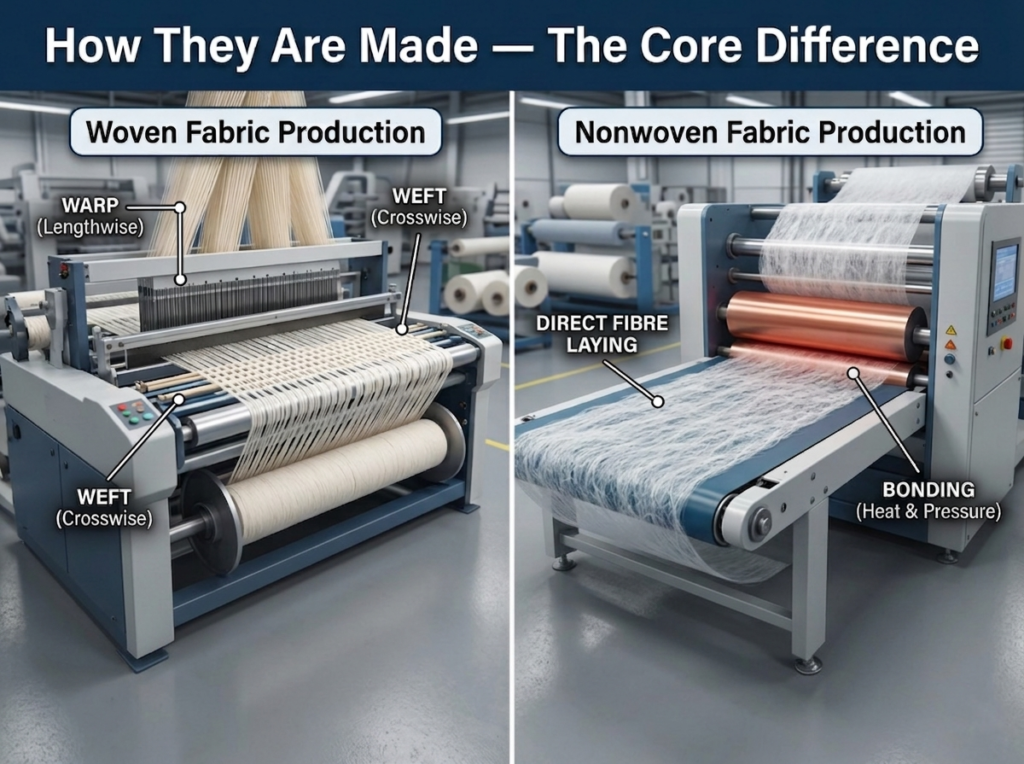
How They Are Made — The Core Difference
Woven fabrics are produced by interlacing two sets of yarns — the warp (lengthwise) and the weft (crosswise) — on a loom. This traditional textile process creates a dimensionally stable fabric with a defined structure. Nonwoven fabrics skip the spinning and weaving steps entirely. Instead, fibres or filaments are directly laid into a web and bonded together through heat, pressure, or chemical processes — producing a flat sheet structure without any yarn interlacing.
Head-to-Head Comparison
| Property | Nonwoven Fabric | Woven Fabric |
|---|---|---|
| Production method | Direct fibre-to-fabric (no yarn, no loom) | Yarn spinning → loom weaving |
| Production speed | Very fast — high volume per hour | Slower — yarn and weave steps |
| Cost | Lower — fewer production steps | Higher — more labor and equipment |
| Strength (MD) | Good to excellent (spunbond) | Excellent — especially on-grain |
| Drape and softness | Good to excellent (varies by type) | Very good — natural drape |
| Barrier properties | Excellent with meltblown layer (SMS) | Low — woven is generally porous |
| Customization | Highly flexible — GSM, width, finish | Limited by yarn and weave pattern |
| Recyclability | PP nonwoven: 100% recyclable | Depends on fibre content |
| Best for | Hygiene, medical, protective, agricultural | Apparel, home textiles, heavy-duty industrial |
When to Choose Nonwoven Fabric
- Hygiene products — baby diapers, sanitary napkins, adult incontinence
- Medical and surgical — gowns, drapes, PPE, masks
- Disposable applications — where single-use is required for hygiene or cost reasons
- Agricultural covers — where breathability and UV resistance matter more than durability
- Geotextiles — where consistent pore size and filtration performance are critical
- Packaging — where lightweight, printable, and low-cost materials are preferred
When to Choose Woven Fabric
- Apparel and fashion — where drape, hand feel, and seam strength are essential
- Heavy-load industrial applications — belts, ropes, and structural reinforcement
- Reusable textiles — where washing durability over many cycles is required
- Technical textiles requiring on-grain dimensional stability under sustained stress
Can Nonwoven Replace Woven Fabric?
In many applications, nonwoven fabrics have fully replaced woven alternatives — particularly in hygiene, medical, and disposable markets. The advantages in cost, production speed, and barrier performance make nonwovens the clear choice for these applications. For apparel and heavy-duty industrial uses, woven fabrics remain the superior choice. The decision should always be driven by the specific performance requirements of your product.
Frequently Asked Questions
Is nonwoven fabric as strong as woven?
For most disposable applications, nonwoven fabric provides sufficient strength. High-performance spunbond PP fabric offers tensile strength of 30–80 N/50mm depending on GSM — adequate for hygiene, medical, and agricultural applications. For load-bearing or apparel uses where seam strength is critical, woven fabric remains stronger.
Which is cheaper — nonwoven or woven fabric?
Nonwoven fabric is generally significantly cheaper per square meter than woven fabric of comparable weight. The elimination of yarn spinning and loom weaving steps dramatically reduces production cost. For high-volume disposable applications, nonwoven PP fabric typically costs 20–50% less than equivalent woven material.
Olefins Private Limited manufactures premium PP spunbond and SMS nonwoven fabrics for all major industries.
Request a free sample at info@olefins.net or WhatsApp +92 316 2055400. We respond within 24 hours.
Previous Post
SMS vs SMMS Nonwoven Fabric — What’s the Difference?