



If you source nonwoven fabric for medical, hygiene, or protective applications, you have likely encountered the terms SMS and SMMS. Both are spunmelt fabrics combining spunbond and meltblown layers — but they are not the same product, and choosing the wrong one can affect performance, cost, and compliance.
This article explains exactly what SMS and SMMS nonwoven fabrics are, how they differ in structure and performance, and which applications each is best suited for.
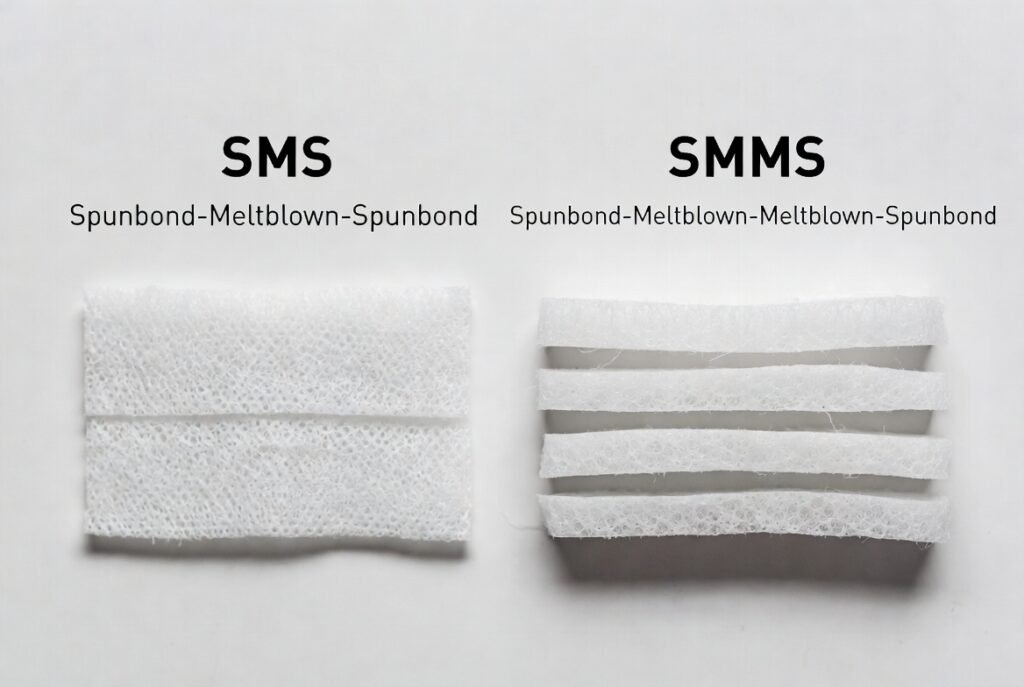
What Does SMS Stand For?
SMS stands for Spunbond-Meltblown-Spunbond. It is a three-layer composite nonwoven fabric made by combining one meltblown layer sandwiched between two spunbond layers, all thermally bonded together in a single production pass.
- S (Spunbond outer layer): Provides strength, tear resistance, and fabric-like hand feel
- M (Meltblown middle layer): Provides the barrier — filtration, liquid repellency, and bacterial protection
- S (Spunbond inner layer): Second strength layer that protects the fragile meltblown and provides softness on the interior
What Does SMMS Stand For?
SMMS stands for Spunbond-Meltblown-Meltblown-Spunbond. It is a four-layer composite with two meltblown layers instead of one. This doubled meltblown core provides significantly enhanced barrier performance compared to SMS at the same total GSM.
- S: Outer spunbond for durability
- M + M: Double meltblown layer — twice the barrier filtration and liquid resistance
- S: Inner spunbond for comfort and structural integrity
Olefins SMS and SMMS fabrics — Head-to-Head Comparison
| Property | SMS | SMMS |
|---|---|---|
| Layer structure | 3 layers (S-M-S) | 4 layers (S-M-M-S) |
| Barrier performance | Good | Excellent (30–50% better) |
| Hydrostatic head pressure | 30–60 cm H₂O typical | 60–100+ cm H₂O typical |
| Bacterial filtration | BFE > 95% at standard GSM | BFE > 99% at same GSM |
| Fabric softness | Excellent | Very good |
| Cost | Lower | 10–20% higher than SMS |
| Typical GSM range | 20–70 GSM | 20–60 GSM |
| Best applications | Surgical caps, light gowns, hygiene backsheets | Surgical gowns Level 2–4, PPE, medical drapes |
When to Choose SMS
SMS nonwoven fabric is the right choice when you need a balance of softness, strength, and moderate barrier performance at the lowest cost:
- Surgical caps, shoe covers, and visitor gowns — where high barrier is not required
- Baby diaper backsheets — for liquid resistance without premium barrier specification
- Light-duty disposable coveralls for food processing or light industrial use
- Feminine hygiene product components where moisture management matters more than barrier
When to Choose SMMS
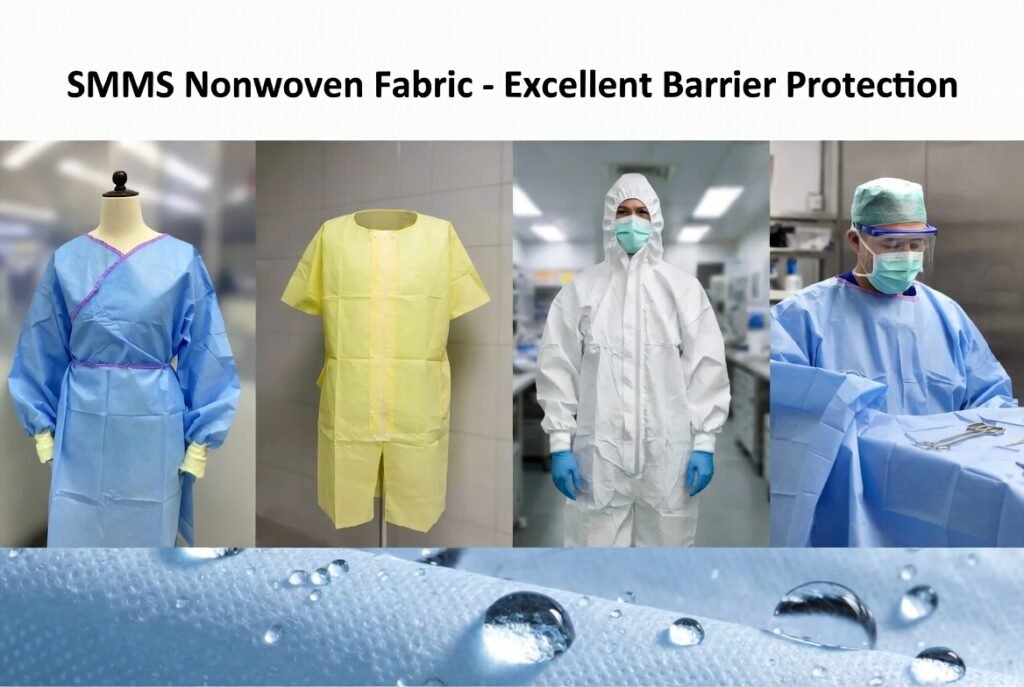
SMMS is the specification to choose when maximum barrier performance is required — typically where infection control, chemical exposure, or fluid penetration is a critical risk:
- Surgical gowns — AAMI Level 2, 3, or 4 rated — where fluid resistance is performance-critical
- Isolation gowns for infectious disease environments
- High-risk PPE coveralls for healthcare, laboratory, and hazmat applications
- Medical drapes for sterile surgical procedures
- Any application requiring hydrostatic pressure resistance above 60 cm H₂O
SSMMS and Other Constructions
Beyond SMS and SMMS, some manufacturers offer SSMMS (two spunbond layers on the outside) and other constructions for specific performance requirements. For most standard medical and hygiene applications, SMS and SMMS cover the full range of specifications. Ask your supplier for test data comparing their specific construction to your performance requirement.
Key Testing Standards for SMS and SMMS Fabric
- ASTM F1670/F1671 — Synthetic blood and viral penetration resistance
- ASTM D5733 — Trapezoid tear strength
- ASTM D5034 — Grab tensile strength
- EN 13795 — European standard for surgical drapes and gowns
- ISO 22609 — Resistance to penetration by blood-borne pathogens
Olefins Private Limited manufactures SMS and SMMS nonwoven fabrics for medical, hygiene, and safety applications. Available in 20–70 GSM with hydrophobic or hydrophilic
Contact us at info@olefins.net or WhatsApp +92 316 2055400 for a free sample and quotation.
Previous Post
Non-Woven Fabric for Baby Diapers — Complete Guide