

What Is GSM in Nonwoven Fabric? How to Choose the Right Weight [2026 Guide]
Most procurement managers learn about GSM the hard way — a rejected production batch, a diaper that leaks during quality testing, or a surgical gown that fails a barrier inspection. GSM (grams per square metre) is the single most critical specification in nonwoven fabric sourcing, yet it is consistently underspecified by buyers who are new to the category.
This guide explains exactly what GSM means in the context of spunbond, SMS, and SMMS nonwoven fabrics, which weight ranges are right for each application, and how to communicate your GSM requirements clearly when requesting quotes or samples from a manufacturer.
What Does GSM Mean in Nonwoven Fabric?
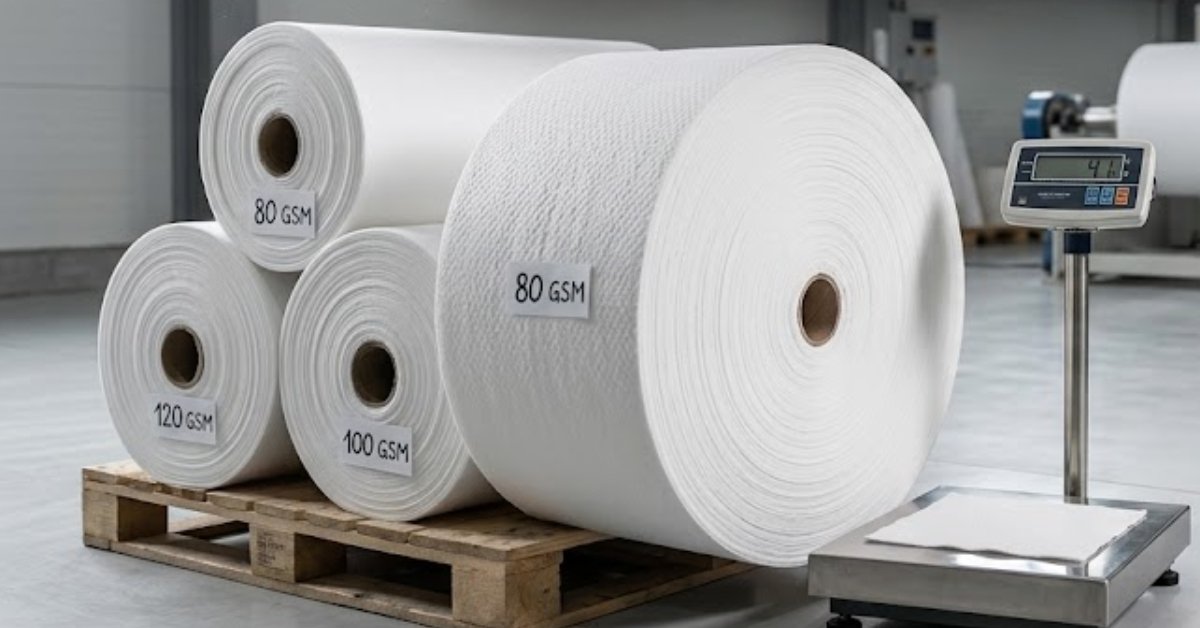
GSM stands for grams per square metre — a universal measure of how much a one-square-metre piece of fabric weighs. That single number directly reflects the fabric’s thickness, tensile strength, and barrier performance.
Unlike woven textiles where thread count signals density, nonwoven fabrics are bonded through thermal, chemical, or mechanical processes. GSM is the standardised way to communicate material density across all nonwoven constructions — whether you’re buying spunbond PP, SMS, or SMMS.
Quick Formula: GSM = Weight of fabric sample (grams) ÷ Area of fabric sample (m²)
Example: A 10cm × 10cm sample (= 0.01 m²) weighing 0.20g = 20 GSM | Testing standard: ISO 9073-1 / EDANA WSP 130.1
GSM Ranges by Application — The Buyer’s Reference Chart
Different applications have different GSM requirements. Using the wrong weight results in either product failure or unnecessary material cost. Use this chart as your reference before placing any nonwoven fabric order.
| Application | GSM Range | Fabric Type | Critical Property |
|---|---|---|---|
| Baby diaper topsheet | 12–18 GSM | Spunbond PP | Softness, liquid passthrough |
| Sanitary napkin topsheet | 15–22 GSM | Spunbond PP | Skin comfort, moisture wicking |
| Baby wet wipe substrate | 30–50 GSM | Spunlace / Spunbond | Wet strength, softness |
| Surgical gown | 35–50 GSM | SMS | Liquid barrier + drapeability |
| Surgical drape | 45–70 GSM | SMMS | High liquid resistance |
| Isolation gown | 25–40 GSM | SMS | Barrier + breathability |
| Light coverall (cleanroom) | 30–40 GSM | Spunbond | Particulate barrier, strength |
| Heavy coverall (chemical) | 50–70 GSM | SMS | Chemical resistance |
| Apparel interlining | 25–50 GSM | Spunbond | Shape retention, hand feel |
| Geotextile (road) | 100–200+ GSM | Spunbond / Needlepunch | Load bearing, drainage |
| Agricultural frost cover | 15–30 GSM | Spunbond | Light transmission + strength |
| Mattress cover | 60–80 GSM | Spunbond | Shape stability, durability |
How GSM Affects Performance in Practice
In Hygiene Products — Lighter Is Non-Negotiable
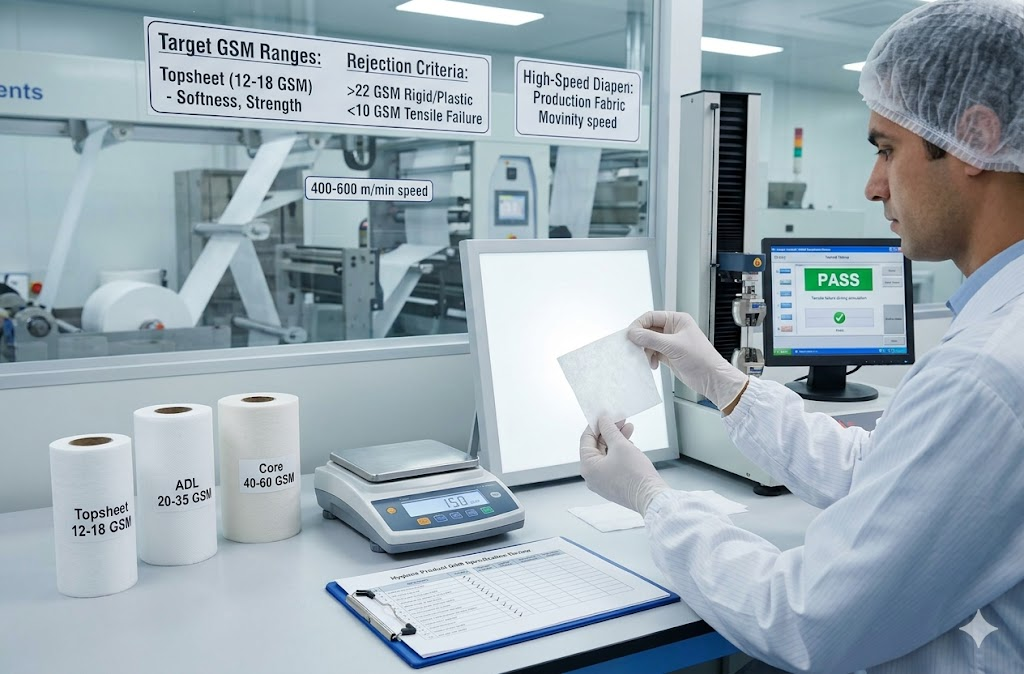
Hygiene products demand the lowest GSM ranges. A baby diaper topsheet at 12–18 GSM must be soft against infant skin yet strong enough to survive high-speed converting lines running at 400–600 m/min. Going above 22 GSM on a topsheet produces a product that feels rigid and plastic-like — brand owners will reject it in quality review.
Going below 10 GSM causes inconsistent web formation and tensile failure during lamination. The acquisition distribution layer (ADL) typically runs at 20–35 GSM to provide the bulk needed for fluid distribution. Each component in a hygiene product assembly has its own tight GSM specification — this is why buying from a manufacturer who understands hygiene nonwoven fabric converting is essential.
In Medical Fabrics — Barrier-to-Weight Ratio Determines Value
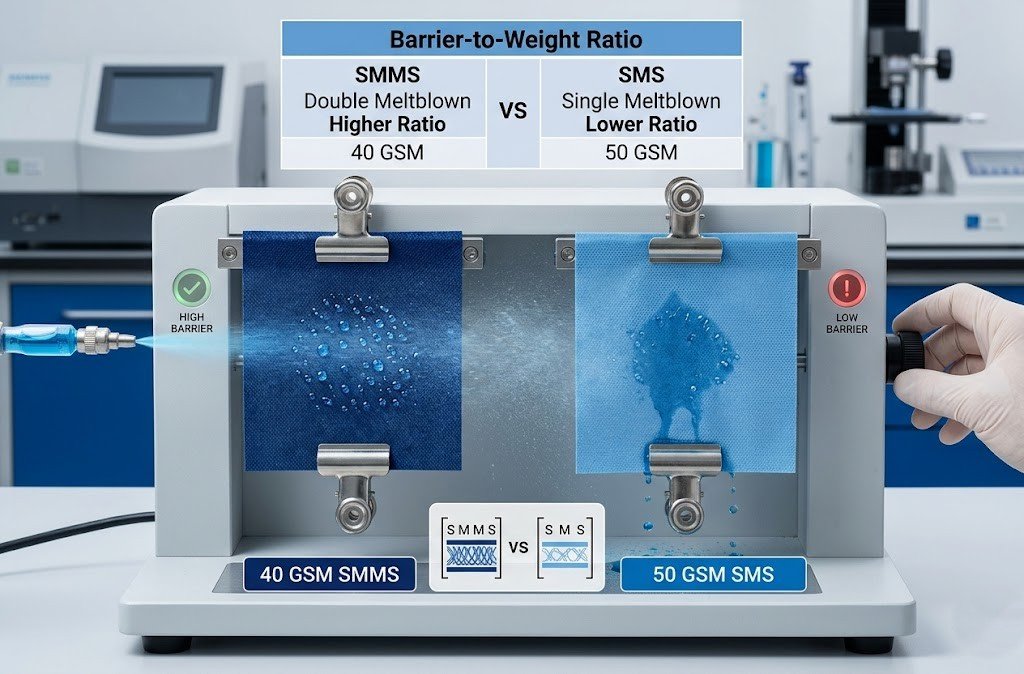
Medical nonwoven fabric must balance barrier performance, sterility, and drapeability. The key insight most buyers miss: SMMS (Spunbond-Meltblown-Meltblown-Spunbond) delivers a higher barrier-to-weight ratio than SMS because its double meltblown layer provides superior filtration at the same or lower total GSM.
In practical terms: you can specify 40 GSM SMMS and achieve better liquid barrier protection than 50 GSM SMS. This is significant for buyers managing cost — the lower GSM SMMS material costs less per metre yet performs better on the critical barrier specification. For a full overview of available constructions, explore Olefins’ medical SMS SMMS fabric range.
In Safety Coveralls — Higher GSM for Structural Integrity
Protective coveralls require higher GSM for abrasion resistance under rough industrial conditions. Cleanroom coveralls use 30–40 GSM spunbond. Chemical protection applications use 50–70 GSM SMS with appropriate hydrophobic treatment. Going below the minimum GSM for a safety application risks seam failure and surface abrasion that compromises the protective function — and creates serious liability.
SMS vs SMMS — Does the Construction Change the GSM You Need?
Yes. Because SMMS has superior barrier performance at lower weight, the GSM requirements for SMMS applications are typically 5–10 GSM lower than for equivalent SMS applications. When comparing quotes from different suppliers, always compare construction AND GSM together, never GSM alone.
How to Specify GSM in a Purchase Order
When placing an RFQ or purchase order for nonwoven fabric, always state: Target GSM ± Tolerance. For example: ’20 GSM ± 1.5 GSM’. Reputable manufacturers test GSM per ISO 9073-1 — sampling multiple positions across the roll width to account for variation in the web formation process.
| Application Type | Recommended GSM Tolerance |
|---|---|
| Hygiene (diaper topsheet, sanitary napkin) | ± 1.0 GSM |
| Medical (surgical gowns, drapes) | ± 2.0 GSM |
| Safety (coveralls, masks) | ± 2.0 GSM |
| Textile and industrial | ± 3.0 GSM |
| High-speed converting lines | ± 0.5 GSM (premium spec — expect a small cost premium) |
Always request a GSM test report with sample shipments. The report should reference the test standard used (ISO 9073-1 is the international standard for nonwoven weight), the number of samples tested, and the range of results across the roll width.
GSM Testing Standards for Nonwoven Fabric
GSM and related quality parameters in nonwoven fabric are verified using the following internationally recognised test methods:
- ISO 9073-1 — Determination of mass per unit area. This is the standard method used to measure a nonwoven fabric’s GSM by weighing a specified sample area under controlled conditions.
- ISO 9073-3 — Determination of tensile strength and elongation. Measures how much force a fabric withstands before breaking and how much it stretches.
- ASTM D5034 — Standard grab test method for breaking strength and elongation, widely requested by North American and international buyers alongside ISO 9073-3.
Frequently Asked Questions — GSM in Nonwoven FabricCan I order a nonwoven fabric with a custom GSM that is not a standard grade?
Yes. Manufacturers like Olefins produce nonwoven fabric to custom GSM specifications as part of OEM supply agreements. Standard stock grades are typically 10, 15, 18, 20, 25, 30, 35, 40, 50, 60, and 70 GSM. Custom weights between or outside these values can be produced with an agreed minimum order quantity. Contact our team at info@olefins.net to discuss your specific requirement.
Does higher GSM always mean better quality nonwoven fabric?
No. Quality in nonwoven fabric means the right GSM for the application, consistently delivered within tolerance. A 35 GSM diaper topsheet is over-specified and will feel rigid against skin. A 15 GSM surgical gown is dangerously under-specified and will fail barrier testing. The relationship between GSM and ‘quality’ is always application-specific.
How do I request a nonwoven fabric sample at a specific GSM from Olefins?
Contact Olefins at info@olefins.net or WhatsApp +92 316 2055400. Provide your required GSM, fabric width, construction preference (Spunbond, SMS, or SMMS), any surface treatment requirement (hydrophilic or hydrophobic), and your end application. Samples are dispatched after confirming specifications. Request a sample here: olefins.net/contact-us/
What is the minimum order for custom GSM nonwoven fabric from Pakistan?
Minimum order quantities vary by construction type and GSM. Contact Olefins directly for MOQ details — we accommodate both product development trial quantities and long-term bulk supply agreements with committed production schedules.
What is the difference between GSM and denier in fabric?
GSM measures weight per unit area (universal across all fabric types). Denier measures the weight of 9,000 metres of a single fibre — it is specific to yarns and filaments. For nonwoven fabric procurement, GSM is the relevant specification. The denier of the base polypropylene fibres affects softness and tensile strength but is typically selected by the manufacturer based on your GSM and performance specification.
Summary — Choosing the Right GSM for Your Application
Can I order a nonwoven fabric with a custom GSM that is not a standard grade?
Yes. Manufacturers like Olefins produce nonwoven fabric to custom GSM specifications as part of OEM supply agreements. Standard stock grades are typically 10, 15, 18, 20, 25, 30, 35, 40, 50, 60, and 70 GSM. Custom weights between or outside these values can be produced with an agreed minimum order quantity. Contact our team at info@olefins.net to discuss your specific requirement.
Does higher GSM always mean better quality nonwoven fabric?
No. Quality in nonwoven fabric means the right GSM for the application, consistently delivered within tolerance. A 35 GSM diaper topsheet is over-specified and will feel rigid against skin. A 15 GSM surgical gown is dangerously under-specified and will fail barrier testing. The relationship between GSM and ‘quality’ is always application-specific.
How do I request a nonwoven fabric sample at a specific GSM from Olefins?
Contact Olefins at info@olefins.net or WhatsApp +92 316 2055400. Provide your required GSM, fabric width, construction preference (Spunbond, SMS, or SMMS), any surface treatment requirement (hydrophilic or hydrophobic), and your end application. Samples are dispatched after confirming specifications. Request a sample here: olefins.net/contact-us/
What is the minimum order for custom GSM nonwoven fabric from Pakistan?
Minimum order quantities vary by construction type and GSM. Contact Olefins directly for MOQ details — we accommodate both product development trial quantities and long-term bulk supply agreements with committed production schedules.
What is the difference between GSM and denier in fabric?
GSM measures weight per unit area (universal across all fabric types). Denier measures the weight of 9,000 metres of a single fibre — it is specific to yarns and filaments. For nonwoven fabric procurement, GSM is the relevant specification. The denier of the base polypropylene fibres affects softness and tensile strength but is typically selected by the manufacturer based on your GSM and performance specification.
GSM is not just a number — it is the primary lever that determines whether your nonwoven fabric performs correctly in production and in the end product. Specify it correctly with a tolerance, request a test report with every sample, and choose a manufacturer who understands the converting process for your specific application.
Olefins Private Limited manufactures spunbond and SMS/SMMS nonwoven fabrics across the full GSM range — from 10 GSM hygiene topsheets to 80+ GSM industrial fabrics. All specifications are customisable. Request a sample or bulk quote today.
Contact us: info@olefins.net | WhatsApp: +92 316 2055400
Related Posts
How to Choose & Source Nonwoven Fabric Manufacturers in Pakistan: Complete Buyer’s Guide
Sourcing high-quality polypropylene (PP) spunbond and composite nonwoven fabrics from Pakistan requires a strategic approach…
Nonwoven Fabric vs Plastic: Why PP Spunbond is the Smarter Choice
Manufacturers and procurement teams frequently face a choice between polypropylene nonwoven fabric and conventional plastic…
Nonwoven Fabric in Pakistan — Industry Overview & Export Capabilities 2026
Pakistan’s textile industry is one of the largest in the world, contributing over 60% of…

How to Choose a Nonwoven Fabric Manufacturer — 10 Questions to Ask Before Buying
Choosing the wrong nonwoven fabric manufacturer can cost you far more than the difference in…