



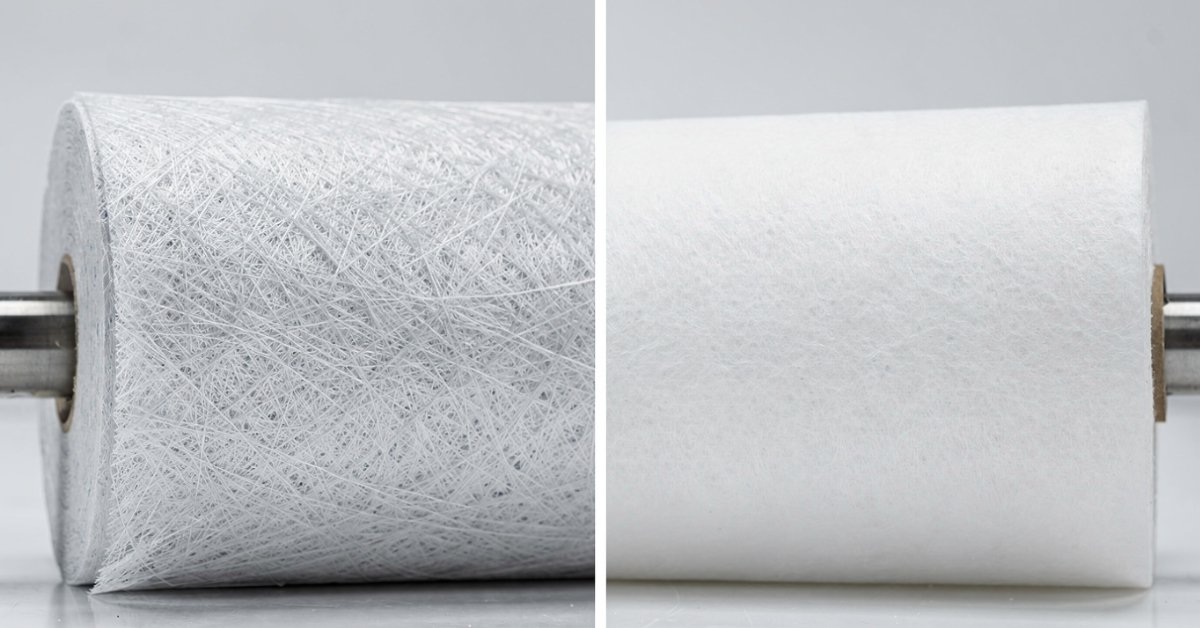
Spunbond vs Spunmelt Nonwoven Fabric: Technical Comparison for Procurement Managers
When you source nonwoven fabric for production, the terms spunbond and spunmelt appear on every datasheet and specification sheet. They are not interchangeable. Specifying the wrong construction for your application can result in product performance failures, converter line issues, or paying a premium for properties you do not need.
This guide breaks down exactly what spunbond and spunmelt (SMS/SMMS) nonwoven fabrics are, how they are manufactured, where each performs best, and how to make the right sourcing decision for your application.
What Is Spunbond Nonwoven Fabric?
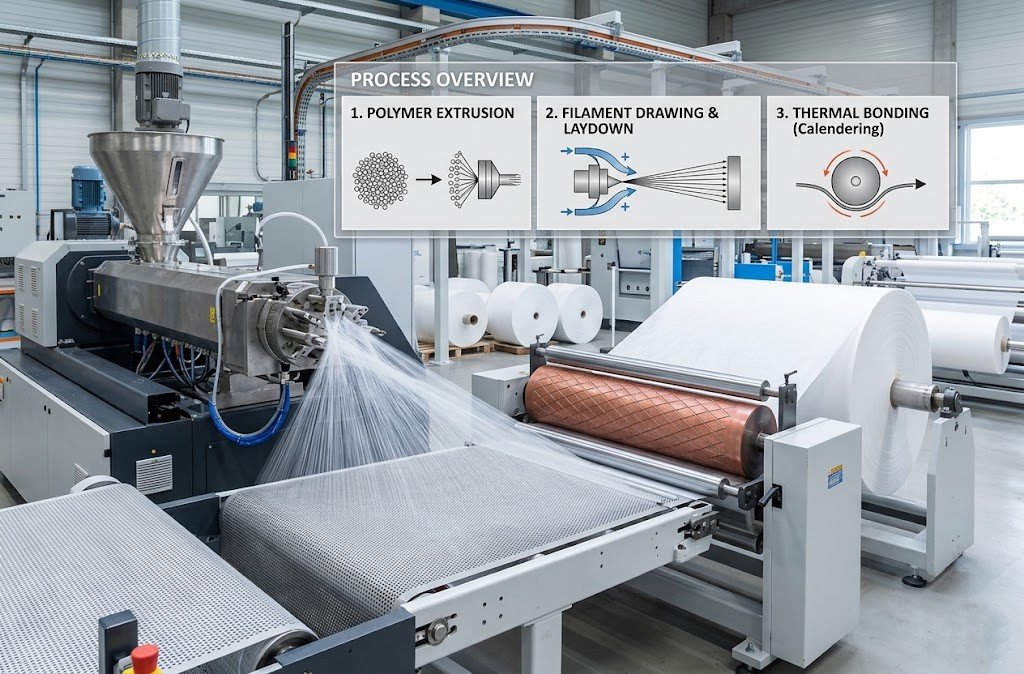
Spunbond nonwoven fabric is produced by extruding continuous filaments of polymer — most commonly polypropylene (PP) — directly onto a moving conveyor belt. The filaments are randomly laid, bonded by heat or pressure, and wound into rolls. The result is a fabric with no weaving or knitting — just a continuous web of bonded fibres.
Because the filaments are continuous (not cut staple fibres), spunbond fabric has excellent tensile strength relative to its weight. It is dimensionally stable, available in a very wide GSM range (8–200+ GSM), and cost-effective for high-volume applications.
| Spunbond Property | Typical Performance |
|---|---|
| Construction | Continuous filaments, thermally or chemically bonded |
| Base Polymer | Polypropylene (PP), sometimes PET or PE |
| GSM Range | 8 GSM (ultra-light) to 200+ GSM (industrial) |
| Barrier Performance | Low-moderate — not a primary barrier fabric |
| Softness | Can be engineered for skin contact — comfort and elite grades |
| Breathability | High — excellent air and moisture vapour permeability |
| Cost | Lower than SMS/SMMS at equivalent GSM |
| Typical Applications | Diaper topsheet, backsheet, coverall base layer, interlining, agricultural covers |
What Is Spunmelt (SMS / SMMS) Nonwoven Fabric?
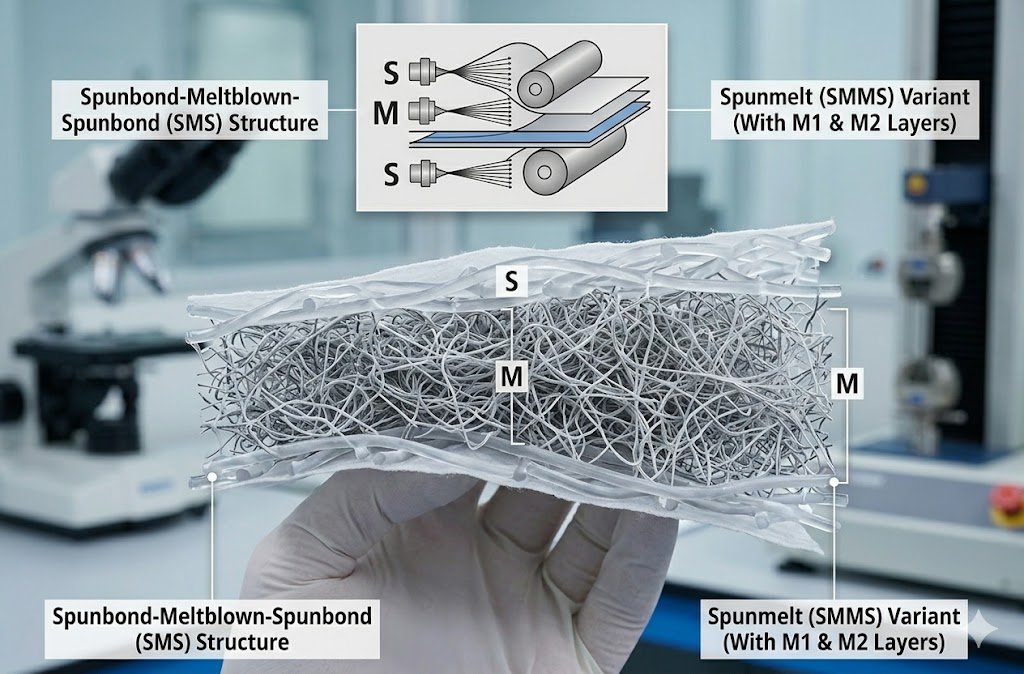
Spunmelt is a composite nonwoven structure that combines spunbond layers with one or more meltblown layers. Meltblown fibres are significantly finer than spunbond filaments — often 1–5 microns in diameter versus 15–35 microns for spunbond. This extremely fine fibre web provides filtration and liquid barrier properties that spunbond alone cannot achieve.
SMS stands for Spunbond-Meltblown-Spunbond: a three-layer structure where the outer spunbond layers provide strength and the central meltblown layer provides the barrier. SMMS adds a second meltblown layer — Spunbond-Meltblown-Meltblown-Spunbond — for enhanced barrier performance, particularly liquid strike-through resistance.
| Spunmelt (SMS/SMMS) Property | Typical Performance |
|---|---|
| Construction | Multi-layer composite: spunbond + meltblown layers bonded together |
| Base Polymer | Polypropylene (PP) |
| GSM Range | 15 GSM (lightweight medical) to 80 GSM (heavy protection) |
| Barrier Performance | High (SMS) to very high (SMMS) — primary barrier fabric |
| Softness | Good — outer spunbond layer is skin-contact suitable |
| Breathability | Moderate — meltblown reduces air permeability vs pure spunbond |
| Cost | 15–35% higher than equivalent spunbond at same GSM |
| Typical Applications | Surgical gowns, drapes, PPE coveralls, face masks, medical packaging |
Spunbond vs SMS vs SMMS — Side-by-Side Comparison
| Property | Spunbond | SMS | SMMS |
|---|---|---|---|
| Liquid Barrier | Low | High | Very High |
| Filtration (particles) | Low | Medium | High |
| Strength / Tear Resistance | High | High | High |
| Softness | High (engineered grades) | Medium-High | Medium-High |
| Breathability | Very High | Medium | Medium-Low |
| Cost (relative) | Lowest | Medium | Higher |
| Primary Use Case | Hygiene, textile, agricultural | Medical, PPE, safety | High-barrier medical, surgical |
| GSM Range (typical) | 8–200+ | 15–80 | 25–70 |
Which Should You Choose?
Choose Spunbond When:
- Your application requires skin softness (diaper topsheets, sanitary napkin topsheets)
- You need high breathability and moisture vapour transfer (agricultural covers, light coveralls)
- Liquid barrier is NOT a primary requirement (interlinings, mattress fabric, agri covers)
- Cost-efficiency is critical and barrier properties are not required
- You need a high GSM base fabric for structural applications (geotextile, mattress)
- Explore our hygiene fabric range for diaper and sanitary napkin applications
Choose SMS When:
- Your application requires a liquid barrier (surgical gowns, isolation gowns, PPE coveralls)
- Face mask production requiring meltblown filtration layer (SMS is the standard construction)
- Protective workwear where splash resistance is needed but not full chemical immersion
- You need a balance of barrier + breathability + reasonable cost
Choose SMMS When:
- Maximum liquid barrier is required (surgical drapes, high-risk zone surgical gowns)
- Your product must meet high-level AAMI PB70 or EN 13795 barrier performance standards
- You want to achieve higher barrier at a lower total GSM (cost efficiency in medical)
- Infection control is the primary function (isolation in high-risk healthcare settings)
- Browse our medical nonwoven fabric range for SMS and SMMS surgical applications
Manufacturing Process — How They Are Made Differently
Spunbond Manufacturing
Polymer chips (typically PP) are melted and extruded through spinnerets to create continuous filaments. The filaments are quenched by cold air, stretched to orient the polymer chains (increasing strength), and deposited onto a moving conveyor in a random pattern. The web is then thermally bonded by passing through heated calendar rolls that press the filaments together at bond points. The result is a dimensionally stable fabric wound into rolls.
Spunmelt (SMS/SMMS) Manufacturing
SMS and SMMS are produced on purpose-built multi-beam lines. The spunbond layers are formed as above. The meltblown layer is produced by extruding molten polymer through extremely fine nozzles with high-velocity hot air blowing the melt into ultra-fine fibres (1–5 microns) that are immediately collected on the conveyor. The layers are consolidated together and thermally bonded in a single pass. The meltblown layer cannot be produced independently — it requires the surrounding spunbond layers for structural integrity.
Frequently Asked Questions — Spunbond vs SpunmeltIs spunmelt the same as SMS?
Spunmelt refers to the broader manufacturing technology that combines spunbond and meltblown layers. SMS is one specific product of that technology (3 layers). SMMS is another (4 layers). All SMS and SMMS fabrics are spunmelt fabrics, but not all spunmelt fabrics are SMS — there are also SSMS, SSMMS, and other constructions for specialized applications.
Can spunbond replace SMS in medical applications?
Only in the lowest barrier classes. Plain spunbond has no meltblown layer, so it
offers no meaningful hydrostatic barrier — fluid passes through under pressure.
It is acceptable for AAMI Level 1 visitor gowns, caps, shoe covers and mask outer
layers, where the requirement is coverage rather than fluid resistance. For AAMI
Level 2 and above, and for anything specified against EN 13795, you need the
meltblown layer that SMS or SMMS provides. If cost is the driver, a lighter SMS
(35 GSM) is almost always a better answer than a heavier spunbond, because the
barrier comes from construction rather than weight.
What GSM should I specify for SMS surgical gowns?
Standard surgical gowns use 35–50 GSM SMS. For higher-risk surgical procedures requiring Level 3 or Level 4 barrier protection (per AAMI PB70), specify 45–70 GSM SMMS. For isolation gowns in standard wards, 25–40 GSM SMS is typically sufficient. Always verify against your product’s target standard.
What is the minimum order for custom GSM nonwoven fabric from Pakistan?
Minimum order quantities vary by construction type and GSM. Contact Olefins directly for MOQ details — we accommodate both product development trial quantities and long-term bulk supply agreements with committed production schedules.
Conclusion
Is spunmelt the same as SMS?
Spunmelt refers to the broader manufacturing technology that combines spunbond and meltblown layers. SMS is one specific product of that technology (3 layers). SMMS is another (4 layers). All SMS and SMMS fabrics are spunmelt fabrics, but not all spunmelt fabrics are SMS — there are also SSMS, SSMMS, and other constructions for specialized applications.
Can spunbond replace SMS in medical applications?
Only in the lowest barrier classes. Plain spunbond has no meltblown layer, so it
offers no meaningful hydrostatic barrier — fluid passes through under pressure.
It is acceptable for AAMI Level 1 visitor gowns, caps, shoe covers and mask outer
layers, where the requirement is coverage rather than fluid resistance. For AAMI
Level 2 and above, and for anything specified against EN 13795, you need the
meltblown layer that SMS or SMMS provides. If cost is the driver, a lighter SMS
(35 GSM) is almost always a better answer than a heavier spunbond, because the
barrier comes from construction rather than weight.
What GSM should I specify for SMS surgical gowns?
Standard surgical gowns use 35–50 GSM SMS. For higher-risk surgical procedures requiring Level 3 or Level 4 barrier protection (per AAMI PB70), specify 45–70 GSM SMMS. For isolation gowns in standard wards, 25–40 GSM SMS is typically sufficient. Always verify against your product’s target standard.
What is the minimum order for custom GSM nonwoven fabric from Pakistan?
Minimum order quantities vary by construction type and GSM. Contact Olefins directly for MOQ details — we accommodate both product development trial quantities and long-term bulk supply agreements with committed production schedules.
Spunbond and spunmelt are complementary fabric constructions — not competing ones. The right choice depends entirely on your application’s barrier requirement, softness specification, and GSM range. Use spunbond where strength and softness matter most. Use SMS or SMMS where liquid barrier and filtration are primary requirements.
Olefins manufactures spunbond and SMS/SMMS nonwoven fabrics across a wide GSM range with custom options for OEM supply. Contact us: info@olefins.net | WhatsApp: +92 316 2055400
Previous Post
What Is GSM in Nonwoven Fabric?
Post a comment
Related Posts
How to Choose & Source Nonwoven Fabric Manufacturers in Pakistan: Complete Buyer’s Guide
Last updated on: August 18, 2026 Sourcing high-quality polypropylene (PP) spunbond and composite nonwoven fabrics…
Nonwoven Fabric vs Plastic: Why PP Spunbond is the Smarter Choice
Last updated on: August 17, 2026 Manufacturers and procurement teams frequently face a choice between…
Nonwoven Fabric in Pakistan — Industry Overview & Export Capabilities 2026
Last updated on: August 13, 2026 Pakistan’s textile industry is one of the largest in…
How to Choose a Nonwoven Fabric Manufacturer — 10 Questions to Ask Before Buying
Last updated on: August 31, 2026 Choosing the wrong nonwoven fabric manufacturer can cost you…