




Introduction
Surgical gowns and medical drapes are the primary barrier between the sterile field and airborne or liquid-borne contamination in an operating theatre. The nonwoven fabric used to manufacture them is not a commodity choice — it is a regulated, performance-critical material governed by international standards and tested to defined barrier levels before it can be used in clinical environments.
SMS (spunbond-meltblown-spunbond) and SMMS (spunbond-meltblown-meltblown-spunbond) polypropylene nonwoven fabrics are the dominant materials for surgical gown and drape construction worldwide. Understanding their construction, barrier performance, and specification requirements is essential for any manufacturer sourcing nonwoven fabric for surgical gowns.
This guide covers everything a surgical gown or medical drape manufacturer needs to know: fabric construction, AAMI and EN 13795 barrier levels, GSM selection, key performance tests, and how to evaluate a surgical gown nonwoven fabric supplier. For full GSM specifications across all hygiene, medical and safety applications, see GSM Nonwoven Fabric Guide.
For a complete overview of all medical-grade nonwoven fabrics we offer, see: Medical Nonwoven Fabric — Full Product Range & Specification Table (Single Source of Truth)
Why SMS & SMMS Nonwoven for Surgical Gowns?
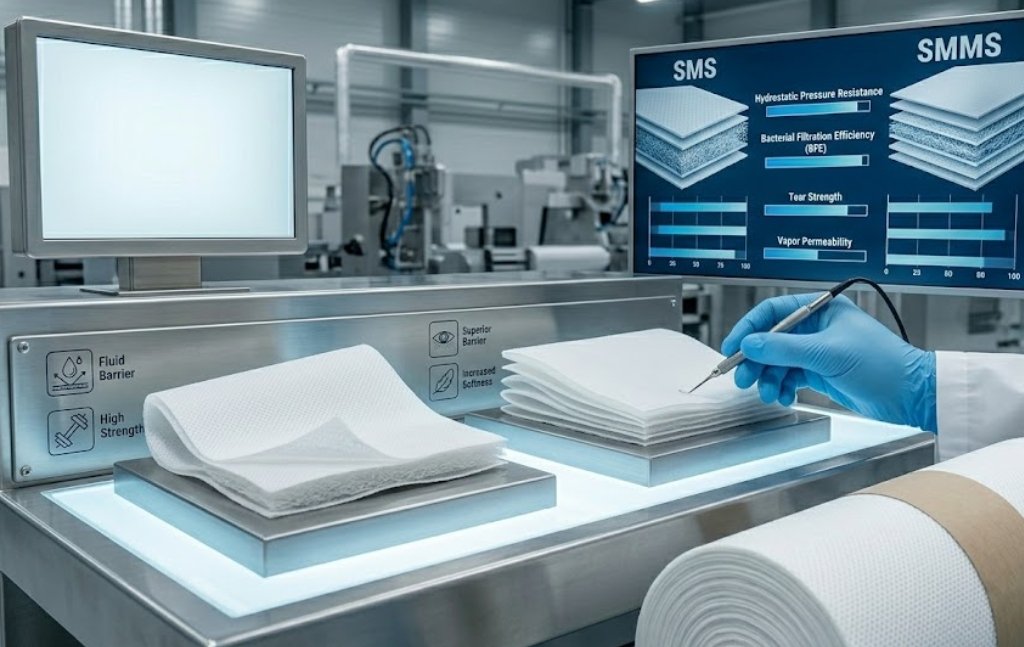
The primary function of surgical gown fabric is to prevent the transfer of liquid-borne micro-organisms from the patient’s body fluids to the surgical team, and from the surgical team to the patient. This requires a fabric that simultaneously blocks liquid penetration while remaining breathable enough for surgical teams to wear for 4–8 hour procedures.
SMS and SMMS nonwoven fabrics achieve this balance through their multi-layer construction. The outer and inner spunbond layers provide tensile strength, abrasion resistance and a soft, comfortable surface. The meltblown middle layer — made of extremely fine polypropylene fibers with diameters of 1–5 microns — creates a dense, tortuous fiber network that blocks liquid while allowing moisture vapour to pass through.
SMS (S-M-S) is a three-layer construction and SMMS (S-M-M-S) uses an extra meltblown layer for more uniform barrier — SMS covers AAMI Level 1-2 isolation, SMMS covers Level 3 surgical gowns where >50 cm H2O is required. Full layer construction, hydrostatic head and cost comparison is covered in our SMS vs SMMS Nonwoven Fabric: Differences & When to Use guide.
AAMI PB70 Barrier Levels — What They Mean for Fabric Specification
The AAMI PB70:2012 standard defines barrier performance levels for surgical and isolation gowns in the US market. For surgical gowns, Level 2 and Level 3 are the relevant levels — full 4-level table with hydrostatic head specifications is listed on our Medical Nonwoven Fabric pillar page and detailed certification mapping on our Medical Nonwoven Fabric Certifications Guide:
| AAMI Level | Test method | Fluid challenge | Recommended fabric | GSM range |
|---|---|---|---|---|
| Level 2 | AATCC 42 + AATCC 127 (≥20 cm H₂O) | Hydrostatic pressure — low | SMS nonwoven | 25–45 GSM |
| Level 3 | AATCC 42 + AATCC 127 (≥50 cm H₂O) | Hydrostatic pressure — moderate | SMS / SMMS | 35–55 GSM |
For the European market, EN 13795-1:2019 is the applicable standard. For a complete explanation of AAMI PB70, EN 13795, ISO 13485 and OEKO-TEX requirements, see: Medical Nonwoven Fabric Certifications — AAMI, EN 13795, ISO & OEKO-TEX Guide
GSM Selection Guide for Surgical Gown Fabric
GSM selection for surgical gown nonwoven fabric is driven by the required barrier level, the intended use zone of the gown (critical zone vs non-critical zone), and the required breathability for the wearing duration. All GSM ranges below are aligned with our Medical Nonwoven Fabric master specification table:
| Gown type | Fabric zone | GSM | Construction | Standard |
|---|---|---|---|---|
| Visitor/isolation gown | Non-critical | 20–30 GSM | SS spunbond | AAMI Level 1 |
| Standard surgical gown | Critical + non-critical | 35–55 GSM | SMS / SMMS | AAMI Level 2–3 (L3 ≥50 cm H₂O) |
| Reinforced surgical gown | Critical zone only | 40–60 GSM | SMMS | AAMI Level 3–4 |
| Surgical drape sheet | Full surface | 40–55 GSM | SMS / SMMS | EN 13795 standard/high |
| Fenestrated surgical drape | Critical zone reinforced | 50–70 GSM | SMMS reinforced | EN 13795 high performance |
Key Performance Tests for Surgical Gown Nonwoven Fabric
Before committing to any surgical gown nonwoven fabric supplier, manufacturers should require test reports covering the following performance parameters:
- Hydrostatic head (ISO 811 / AATCC 127): measures the pressure of water a fabric can withstand before leakage. For AAMI Level 2, minimum 20 cmH₂O is required. For AAMI Level 3, minimum 50 cmH₂O is required. SMMS fabric for Level 4 applications must also achieve >50 cmH₂O and pass viral penetration ASTM F1671.
- Bacterial Filtration Efficiency (BFE — EN 14683): the percentage of bacteria-sized particles blocked by the fabric. Medical-grade SMS nonwoven must achieve BFE > 98% to comply with EN 14683 requirements for surgical masks and applicable gown standards.
- Lint generation (IEST-RP-CC003 / EN 13795): clean-room environments and operating theatres require very low lint release from gown fabric to prevent particle contamination of the surgical site.
- Tensile strength (ISO 29073 / EDANA ERT 20): the fabric must withstand stresses from donning, doffing and typical movement during extended procedures without tearing.
- Breathability / Air permeability (ISO 9237): surgical gown fabric must balance barrier performance against moisture vapour transmission to maintain wearer comfort during long procedures.
Three-Anti Treatment — What It Is and When to Specify It
For surgical gown fabric used in high-risk settings (vascular surgery, orthopaedic surgery, infectious disease procedures), manufacturers often specify ‘three-anti’ treated SMS or SMMS fabric. This refers to a surface treatment package that delivers:
- Anti-alcohol: resistance to isopropyl alcohol penetration — critical as surgical teams use alcohol-based antiseptics and disinfectants routinely
- Anti-blood: enhanced resistance to blood and blood-borne fluid penetration beyond standard hydrophobic treatment
- Anti-static: electrostatic dissipation treatment — reduces particulate attraction in the operating environment
Three-anti treatment is applied as a surface finish on the spunbond outer layer during or after fabric production. It does not significantly affect GSM, breathability or tactile feel but substantially raises the fabric’s chemical barrier performance. Specify three-anti SMS/SMMS when supplying fabric for AAMI Level 4 or EN 13795 High Performance gowns.
Sourcing Surgical Gown Nonwoven Fabric from Olefins, Pakistan
Olefins Private Limited, Karachi, manufactures PP SMS and SMMS nonwoven fabrics for surgical gown and medical drape applications. Our medical fabric range covers:
- SMS nonwoven: 25–45 GSM for light medical, 35–55 GSM for standard surgical gowns (AAMI Level 2–3, Level 3 ≥50 cm H₂O)
- SMMS nonwoven: 35–55 GSM standard, 40–60 GSM for high-barrier surgical and isolation gown applications (AAMI Level 3–4)
- Hydrophobic standard or three-anti treatment on request
- Custom width: 160 cm standard; other widths on request for specific gown pattern cutting requirements
- OEM supply: production against buyer-provided specification sheets with lot-level test reports
- Export to GCC, UAE, Bangladesh, Saudi Arabia: 7–10 days sea freight from Karachi
Frequently Asked Questions — Surgical Gown Nonwoven FabricWhat is the difference between SMS and SMMS fabric for surgical gowns?
SMS (three-layer) provides AAMI Level 2–3 barrier performance and is suitable for standard surgical procedures. SMMS (four-layer, with an additional meltblown layer) provides higher hydrostatic head resistance (Level 3 ≥50 cm H2O) and is used for AAMI Level 3–4 gowns in high-fluid-exposure surgical settings such as vascular or orthopaedic surgery. See full spec table on Medical Nonwoven Fabric pillar page.
What GSM SMS fabric is used for surgical gowns?
Standard surgical gowns use 35–55 GSM SMS/SMMS nonwoven (AAMI Level 2-3, Level 3 requires ≥50 cm H2O hydrostatic head per AATCC 127). Reinforced gowns and high-barrier drapes use 40–60 GSM SMMS. The critical zone (front panel, sleeves) of a reinforced gown may use heavier SMMS while non-critical zones use lighter SMS to balance comfort and protection. Full GSM vs AAMI table on Medical Nonwoven Fabric page.
Does surgical gown nonwoven fabric need to be AAMI certified?
The fabric itself is not AAMI-certified — the finished gown is tested to AAMI PB70. However, fabric suppliers should be able to provide hydrostatic head, BFE, and lint test data that confirms the fabric is capable of meeting the required AAMI level (Level 2 ≥20 cm H2O, Level 3 ≥50 cm H2O) in the finished garment. Request lot-level test reports from any surgical gown nonwoven fabric supplier.
What is the difference between SMS and SMMS fabric for surgical gowns?
SMS (three-layer) provides AAMI Level 2–3 barrier performance and is suitable for standard surgical procedures. SMMS (four-layer, with an additional meltblown layer) provides higher hydrostatic head resistance (Level 3 ≥50 cm H2O) and is used for AAMI Level 3–4 gowns in high-fluid-exposure surgical settings such as vascular or orthopaedic surgery. See full spec table on Medical Nonwoven Fabric pillar page.
What GSM SMS fabric is used for surgical gowns?
Standard surgical gowns use 35–55 GSM SMS/SMMS nonwoven (AAMI Level 2-3, Level 3 requires ≥50 cm H2O hydrostatic head per AATCC 127). Reinforced gowns and high-barrier drapes use 40–60 GSM SMMS. The critical zone (front panel, sleeves) of a reinforced gown may use heavier SMMS while non-critical zones use lighter SMS to balance comfort and protection. Full GSM vs AAMI table on Medical Nonwoven Fabric page.
Does surgical gown nonwoven fabric need to be AAMI certified?
The fabric itself is not AAMI-certified — the finished gown is tested to AAMI PB70. However, fabric suppliers should be able to provide hydrostatic head, BFE, and lint test data that confirms the fabric is capable of meeting the required AAMI level (Level 2 ≥20 cm H2O, Level 3 ≥50 cm H2O) in the finished garment. Request lot-level test reports from any surgical gown nonwoven fabric supplier.
Request Surgical Gown SMS/SMMS Nonwoven Fabric Sample — Olefins Pakistan
info@olefins.net | WhatsApp +92 316 2055400.
Post a comment
Related Posts
Medical Nonwoven Fabric Certifications — ISO 9001 2015
Introduction When sourcing nonwoven fabric, consistent quality and reliable manufacturing processes are essential for B2B…

Face Mask Nonwoven Fabric — Meltblown Filter Media & Spunbond Layer Guide
Introduction A disposable face mask — whether a surgical mask, procedure mask, or N95/KN95 respirator…