



Introduction
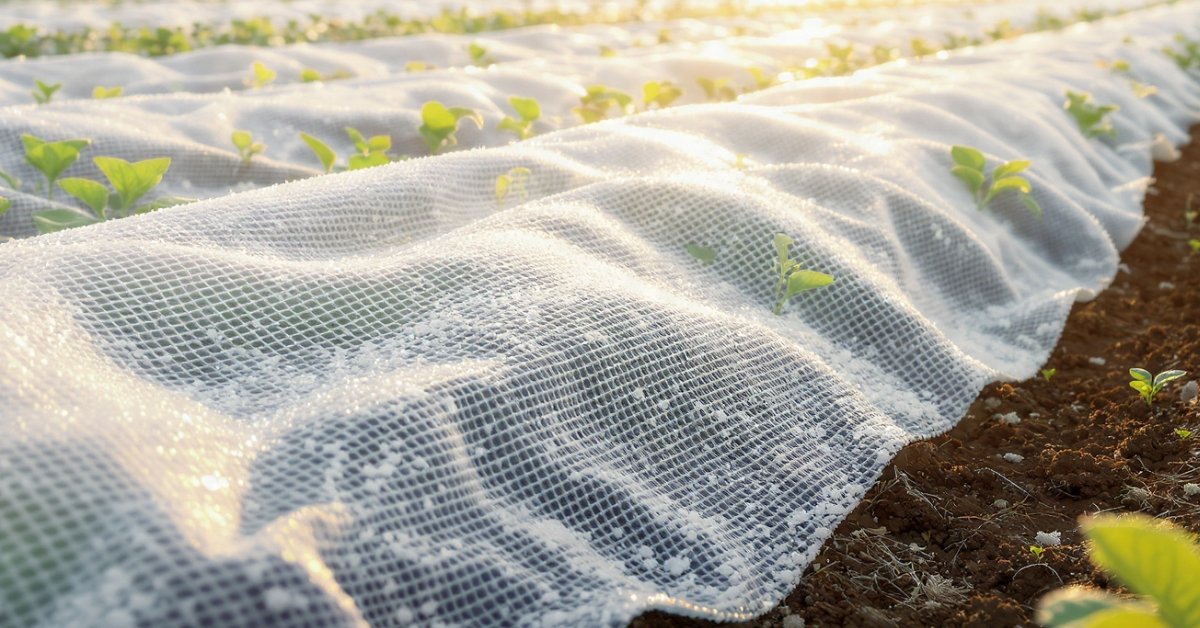
Polypropylene spunbond nonwoven fabric has transformed commercial agriculture over the past three decades. What were once labour-intensive operations — physically covering and uncovering crops to manage temperature, frost risk, insect pressure, and moisture — can now be managed with a single roll of the correct nonwoven fabric at a fraction of the cost of traditional alternatives such as glass, polythene film, or straw mulch.
Agricultural nonwoven fabric is used globally for crop covers (row covers, floating row covers), frost protection fleece, ground mulching, weed suppression, seedling nursery covers, and fruit protection bags. Pakistan-manufactured PP spunbond nonwoven is increasingly competitive for bulk agricultural fabric supply to GCC, South Asian, East African, and Southeast Asian markets where commercial horticulture is expanding rapidly.
This guide covers the specific nonwoven fabric types used for crop covers and mulching, GSM selection for each application, UV-stabilisation requirements, and how to source in bulk from Pakistan.
For a complete overview of all Textile & Industrial grade nonwoven fabrics we offer, see: Textile & Industrial Nonwoven Fabric — Full Product Range
Types of Agricultural Nonwoven Fabric by Application
| Application | Fabric type | GSM range | Key property | Coverage period |
|---|---|---|---|---|
| Light crop cover (row cover) | PP spunbond (hydrophilic) | 10 – 20 GSM | Light transmittance > 85%; breathable | Seasonal |
| Frost protection fleece | PP spunbond (heavier) | 17 – 50 GSM | Thermal retention; frost to -8°C | Winter / overnight |
| Weed suppression mulch | PP spunbond (black) | 50 – 100 GSM | Zero light transmittance; UV-stab | Multi-season (1–3 yrs) |
| Ground cover | PP spunbond or needle-punch | 60 – 150 GSM | UV-stab; erosion control | Permanent |
| Seedling nursery cover | PP spunbond (very light) | 9 – 17 GSM | High light transmission; insect barrier | Short-term |
| Fruit protection bag | PP spunbond (cut & sealed) | 15 – 30 GSM | Insect and pest barrier | Season duration |
| Shade net replacement | PP spunbond (coloured) | 30 – 50 GSM | Controlled light filtration; UV-resist | Multi-season |
| Potted plant cover | PP spunbond (thermal) | 25 – 40 GSM | Wind protection; insulation | Winter |
| Pest barrier fence | Needle-punched / thick spunbond | 80 – 120 GSM | High physical integrity; UV-stab | Permanent / 2-3 yrs |
| Soil heating cover | SMS nonwoven | 30 – 60 GSM | Enhanced thermal insulation | Early spring |
To understand SMS construction for enhanced thermal insulation,
see: SMS vs SMMS Nonwoven Fabric — What’s the Difference?
Shade Net / Shading Fabric
A woven or nonwoven fabric that reduces sunlight intensity for shade-loving crops. Shading percentages typically 30–80%. Protects against sunscald and heat stress in hot climates like Pakistan and the Middle East.
Frost Protection Nonwoven Fabric — How It Works and How to Specify It
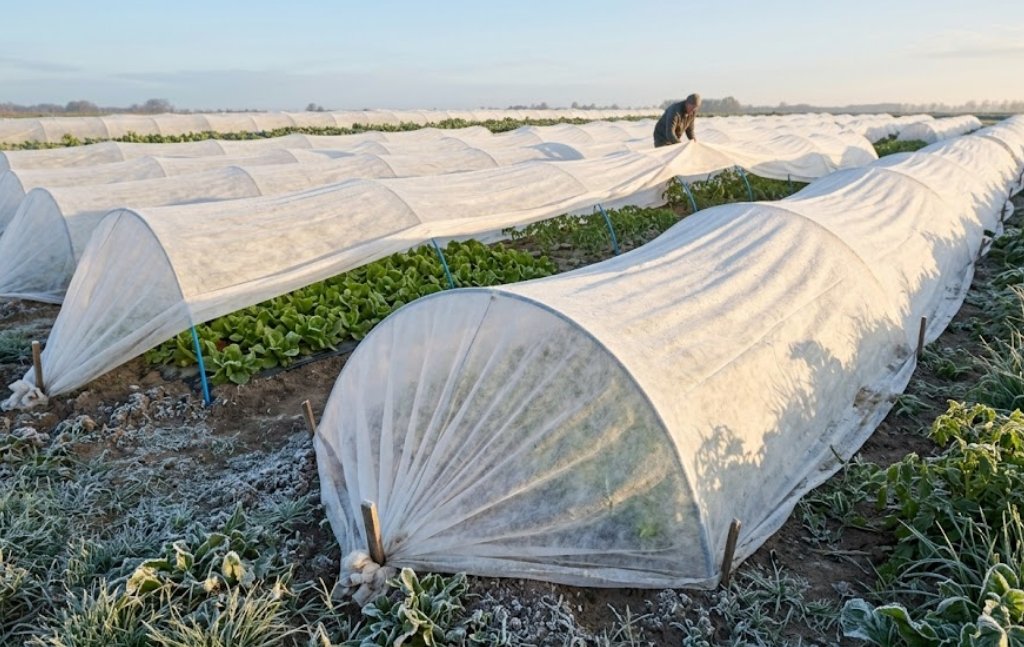
Frost protection fleece is one of the highest-value agricultural nonwoven applications. When laid directly over crops or fruit trees, spunbond PP nonwoven fabric creates a microclimate under the cover that is 2–8°C warmer than the ambient air temperature, depending on the fabric GSM and the still-air conditions of the night.
The thermal retention mechanism works through a combination of trapping radiated heat from the soil and crop, reducing convective heat loss from the plant canopy surface, and providing a physical barrier against frost crystal formation directly on plant tissue. The fabric must be permeable to moisture vapour — a fully impermeable material like polythene film would cause condensation and fungal disease under the cover.
| GSM | Frost protection to approx. | Light transmittance | Recommended use |
|---|---|---|---|
| 10 – 17 GSM | -1°C to -2°C | 85 – 95% | Early season frost protection |
| 17 – 25 GSM | -2°C to -4°C | 75 – 85% | Vegetables, strawberries, salads |
| 30 GSM | -4°C to -5°C | 65 – 75% | Citrus, stone fruit, tender veg |
| 50 GSM | -6°C to -8°C | 40 – 55% | Overwintering crops, young orchards |
| 80 – 100 GSM | -10°C+ (w/ trapped air) | < 20% | Full winter cover for dormant plants |
Frost protection fleece is used in one of two configurations: direct contact with the crop canopy (floating row cover — no frame required) or over-frame cover (tunnel or low hoop system). For direct-contact use, the fabric must be very light (10–30 GSM) and have a soft, non-abrasive surface that will not damage tender foliage, flowers, or fruit under wind movement.
UV Stabilisation — Critical for Multi-Season Agricultural Fabric
Polypropylene degrades rapidly under ultraviolet radiation without UV stabilisation. An unstabilised PP spunbond fabric exposed to full outdoor sunlight will lose more than 50% of its tensile strength within 4–8 weeks. For agricultural fabric that needs to remain functional across a full growing season or multiple seasons, UV stabilisation is non-negotiable.
UV stabilisers — typically HALS (Hindered Amine Light Stabilisers) and UV absorbers — are added to the PP polymer before fibre extrusion during spunbond production. The effectiveness of UV stabilisation is tested by exposing fabric samples to a defined dose of UV radiation (ASTM D4355 or ISO 4892) and measuring retained tensile strength after 500 hours of artificial UV exposure.
| UV stabilisation level | Retained strength after 500h UV | Service life estimate | Recommended for |
|---|---|---|---|
| Standard PP | < 30% | 4 – 8 weeks outdoor | Single-use / short-term covers |
| Light UV stabilisation | 50 – 70% | 1 season (4–6 months) | Single-season row covers |
| Medium UV stabilisation | 70 – 85% | 2 – 3 seasons | Weed mulch, multi-season cover |
| High UV stabilisation | > 85% | 3 – 5 seasons | Ground cover, permanent weed control |
Always request a UV resistance test certificate when sourcing agricultural PP nonwoven fabric for multi-season applications. Suppliers who cannot provide this data are likely supplying unstabilised or under-stabilised fabric that will fail prematurely in the field.
Weed Suppression & Mulching Nonwoven Fabric
Black or black/white PP spunbond nonwoven fabric used as ground mulch suppresses weed growth by blocking sunlight from reaching the soil surface while remaining permeable to water and air. It is increasingly preferred over polythene mulch film because it allows rainfall and irrigation water to penetrate to the root zone, avoids the waterlogging that can occur under impermeable film in heavy rainfall, and does not trap condensation that promotes fungal pathogens.
Key specifications for weed suppression mulching nonwoven fabric:
- GSM: 50–100 GSM black PP spunbond — heavier GSM provides better weed suppression and longer service life
- Colour: black (standard for light blocking); black on one side / white on the other for reflective mulch that improves fruit colouring in orchards (increased light reflection into the canopy)
- UV stabilisation: multi-season weed mulch requires medium to high UV stabilisation — specify 2–3 season service life minimum
- Water permeability: fabric must allow rainfall of at least 50 mm/hour to pass through without surface runoff — test to ISO 11058 or equivalent
- Width: specify the bed width you need to cover; standard widths are 1.6m, 2.1m, 3.2m, 4.2m.
- Roll length: standard rolls are 100-500m; specify what works for your field size.
For heavy-duty ground cover and erosion control fabrics,
see: Geotextile Nonwoven Fabric — Road, Drainage & Erosion Control Supplier
Pakistan-Specific Applications
In Pakistan’s agricultural sector, nonwoven fabric is gaining rapidly growing adoption for cotton, vegetables, strawberry cultivation, and tobacco farming. The hot summer climate makes UV-stabilized shading fabric particularly valuable, while the cooler northern highland winters create demand for frost protection covers. Pakistani manufacturers using locally produced agricultural nonwoven from Olefins benefit from competitive pricing and shorter supply chains compared to imported alternatives.
Sourcing Crop Cover Nonwoven Fabric from Olefins, Pakistan
Olefins Private Limited manufactures PP spunbond nonwoven fabric for agricultural crop cover and mulching applications:
- Light crop cover and frost protection fleece: 10–50 GSM white PP spunbond with light UV stabilisation for single to multi-season use
- Black weed mulch fabric: 50–100 GSM black PP spunbond with medium UV stabilisation — available in standard and wide widths
- Black/white mulch fabric: 40–60 GSM two-tone for reflective orchard mulch applications
- UV stabilisation levels: specified to customer requirement — standard, medium and high UV stabilisation grades available
- Roll formats: jumbo rolls for agricultural distributors; cut-to-length for packaged retail product
- OEM and private label: bulk supply to agricultural product distributors across GCC, Bangladesh, East Africa and Southeast Asia
- Custom width and GSM: production to buyer specification — agricultural requirements vary significantly by crop and geography
Frequently Asked Questions — Crop Cover Nonwoven FabricWhat GSM crop cover fabric should I use for frost protection?
For light frost protection (−2°C to −4°C), use 17–25 GSM PP spunbond crop cover fabric. For stronger protection down to −5°C, use 30 GSM. For serious winter protection of tender or high-value crops, 50 GSM frost protection fleece will protect to −8°C. Heavier GSM also reduces light transmittance, so weigh the crop’s light requirement against the degree of frost protection needed.
What is the difference between crop cover fabric and mulch fabric?
Crop cover fabric (row cover, frost fleece) is placed over the crop canopy to create a protected microclimate — it must be light (10–50 GSM), high light-transmitting, and breathable. Mulch fabric is placed on the ground surface around the plant base to suppress weeds and retain moisture — it is heavier (50–100 GSM), opaque (black), and designed for multi-season ground use rather than plant canopy coverage.
How long does agricultural nonwoven fabric last outdoors?
Service life depends entirely on GSM and UV stabilisation level. Lightly stabilised 17–20 GSM frost fleece used seasonally and stored during summer will last 3–5 seasons. Medium UV-stabilised weed mulch (40–60 GSM) provides 2–3 seasons of continuous outdoor use. Unstabilised PP fabric degrades within 4–8 weeks of full sun exposure. Always specify and verify the UV stabilisation level and expected service life from your supplier before purchasing.
What GSM crop cover fabric should I use for frost protection?
For light frost protection (−2°C to −4°C), use 17–25 GSM PP spunbond crop cover fabric. For stronger protection down to −5°C, use 30 GSM. For serious winter protection of tender or high-value crops, 50 GSM frost protection fleece will protect to −8°C. Heavier GSM also reduces light transmittance, so weigh the crop’s light requirement against the degree of frost protection needed.
What is the difference between crop cover fabric and mulch fabric?
Crop cover fabric (row cover, frost fleece) is placed over the crop canopy to create a protected microclimate — it must be light (10–50 GSM), high light-transmitting, and breathable. Mulch fabric is placed on the ground surface around the plant base to suppress weeds and retain moisture — it is heavier (50–100 GSM), opaque (black), and designed for multi-season ground use rather than plant canopy coverage.
How long does agricultural nonwoven fabric last outdoors?
Service life depends entirely on GSM and UV stabilisation level. Lightly stabilised 17–20 GSM frost fleece used seasonally and stored during summer will last 3–5 seasons. Medium UV-stabilised weed mulch (40–60 GSM) provides 2–3 seasons of continuous outdoor use. Unstabilised PP fabric degrades within 4–8 weeks of full sun exposure. Always specify and verify the UV stabilisation level and expected service life from your supplier before purchasing.
Request Agricultural Crop Cover Nonwoven Fabric Sample — Olefins Pakistan
info@olefins.net | WhatsApp +92 316 2055400.
Post a comment
Related Posts
Nonwoven Interlining Fabric — Fusible & Non-Fusible Guide for Apparel Manufacturers
Introduction Interlining fabric is the hidden structural element in almost every garment that holds its…

Geotextile Nonwoven Fabric — Road, Drainage & Erosion Control Guide
Introduction Geotextiles are one of the largest volume applications for nonwoven fabric globally — second…
Nonwoven Fabric for Furniture: Backing, Dust Cover & Padding Guide
The furniture industry is one of the largest consumers of nonwoven fabric — yet it…