


Introduction
Geotextiles are one of the largest volume applications for nonwoven fabric globally — second only to hygiene in terms of total tonnage consumed. Every major infrastructure project — road construction, railway embankments, coastal protection, drainage channels, retaining walls, and landfill liners — relies on geotextile fabric to separate, filter, drain, reinforce, or protect the surrounding soil.
Nonwoven polypropylene spunbond and needle-punched geotextile fabrics are the workhorses of civil engineering and infrastructure projects worldwide. Understanding the difference between geotextile fabric types, how to specify the correct GSM and function class for each application, and how to evaluate a geotextile nonwoven fabric supplier is essential knowledge for project engineers, procurement managers, and distributors.
This guide covers geotextile fabric functions, construction types, GSM selection for road, drainage and erosion applications, key performance tests, and sourcing from Pakistan.
For a complete overview of all Textile & Industrial grade nonwoven fabrics we offer, see: Textile & Industrial Nonwoven Fabric — Full Product Range
What Is Nonwoven Geotextile Fabric?
Geotextile fabric is a permeable textile material placed in contact with soil to perform one or more of five engineering functions: separation, filtration, drainage, reinforcement, or erosion control. Nonwoven geotextile fabric — as distinguished from woven geotextile — is manufactured either by the spunbond process (continuous filaments thermally bonded) or by the needle-punch process (staple fibers mechanically entangled using barbed needles).
| Construction type | Process | Structure | Strength | Permeability | Best function |
|---|---|---|---|---|---|
| Spunbond nonwoven | Continuous PP filament + thermal bond | Flat, uniform | Moderate | High — isotropic flow | Filtration, drainage separation |
| Needle-punched nonwoven | Staple fibre + needle entanglement | Lofted, three-dimensional | High — multi-directional | Very high — in-plane flow | Drainage, erosion control, reinforcement |
| Woven geotextile | PP or PET woven tapes | Grid-like | Very high — tensile | Moderate — through-plane only | Reinforcement, load distribution |
For most road, drainage and erosion applications, nonwoven geotextile (either spunbond or needle-punched PP) is the specified fabric type because it provides isotropic permeability — allowing water to flow through the fabric in any direction — combined with the filtration efficiency needed to retain soil particles while permitting free water drainage.
The Five Functions of Geotextile Nonwoven Fabric
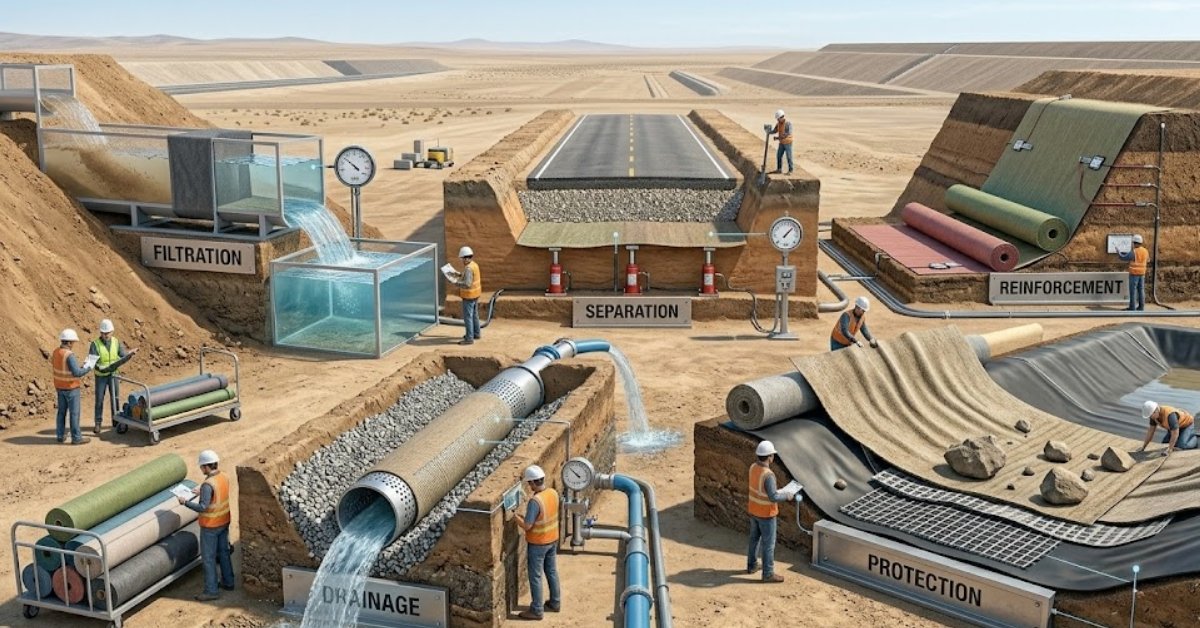
1. Separation
Placed between two dissimilar soil layers (e.g., sub-base aggregate over soft subgrade clay), the geotextile prevents the two materials from mixing under traffic or loading. Without separation, aggregate sub-base gradually becomes contaminated with fine clay particles, losing its load-bearing capacity and requiring costly replacement. A 100–150 GSM spunbond geotextile beneath a road sub-base can double the effective service life of the pavement structure.
2. Filtration
The geotextile acts as a filter medium — allowing water to pass freely while retaining soil particles and preventing piping (the migration of fine particles that can destabilise a slope or embankment). The key parameter is Apparent Opening Size (AOS / O90), which must be matched to the particle size distribution of the adjacent soil to prevent either clogging (if too tight) or piping (if too open).
3. Drainage
Needle-punched nonwoven geotextile has significant in-plane transmissivity — water can travel laterally through the fabric to a drainage outlet. This function is used in slope drainage, retaining wall drainage layers, and pavement edge drains to intercept and redirect groundwater away from load-bearing structures.
4. Reinforcement
High-tensile geotextile fabric increases the load-bearing capacity of soft subgrades by distributing point loads laterally. While woven geotextiles generally deliver higher tensile strength for pure reinforcement applications, heavyweight needle-punched nonwovens (200–400 GSM) are used where combined reinforcement and drainage functions are needed simultaneously.
5. Erosion control
Geotextile laid on slopes, channel banks or coastal embankments protects the soil surface from erosive forces — rainfall impact, surface water flow, and wave action — by covering the soil while allowing vegetation to establish. UV-stabilised PP nonwoven is specified for permanent erosion control applications.
GSM Selection Guide by Application
| Application | GSM range | Primary function | Key spec |
|---|---|---|---|
| Road sub-base separation (light traffic) | 80 – 120 GSM | Separation + filtration | AOS O90 < 150 micron; CBR puncture > 1.0 kN |
| Road sub-base separation (heavy duty) | 120 – 200 GSM | Separation + reinforcement | Tensile strength > 10 kN/m; elongation < 50% |
| French drain / trench drain wrapping | 100 – 150 GSM | Filtration + drainage | Permittivity > 0.3 s-1; AOS matched to soil |
| Slope erosion control | 80 – 150 GSM | Erosion protection | UV-stabilised PP; wide roll width for coverage |
| Retaining wall drainage layer | 150 – 250 GSM | In-plane drainage | High transmissivity needle-punched fabric |
| Coastal / riverbank protection | 200 – 400 GSM | Erosion + reinforcement | High puncture resistance; UV-stabilised |
| Landfill drainage / protection layer | 200 – 500 GSM | Protection of geomembrane | High CBR puncture resistance > 4.5 kN |
| Agricultural drainage (subsurface) | 80 – 120 GSM | Filtration around drainage pipe | AOS suited to local soil; high flow rate |
To understand how GSM affects puncture resistance and flow rate,
see: What Is GSM in Nonwoven Fabric? GSM Meaning, Chart & How to Choose
Key Performance Tests for Geotextile Nonwoven Fabric
When specifying or procuring geotextile nonwoven fabric, the following tests are standard requirements for most civil engineering projects:
- Mass per unit area / GSM (EN ISO 9864 / ASTM D5261): the fundamental specification parameter. Request per-roll certificates showing actual GSM with ±10% tolerance conformance.
- Tensile strength and elongation (EN ISO 10319 / ASTM D4595): wide-width strip tensile test. Strength expressed in kN/m; elongation at break is equally important — high elongation can cause unacceptable deformation under load.
- CBR puncture resistance (EN ISO 12236 / ASTM D6241): resistance to puncture by a standard probe under a compressive load. Critical for geotextiles installed under sharp angular aggregate, where puncture failure would immediately compromise separation and filtration function.
- Apparent Opening Size / AOS (EN ISO 12956 / ASTM D4751): determines what particle sizes the fabric will retain. Must be specified against the D85 of the adjacent soil to prevent piping failure.
- Permittivity / water flow rate (EN ISO 11058 / ASTM D4491): measures the volume of water passing through the fabric under a unit head of pressure. Critical for filtration and drainage applications.
- UV resistance (EN 12224 / ASTM D4355): for any geotextile used in applications with exposure to sunlight before or during installation, UV stabilisation and retained strength after 500 hours UV exposure must be specified.
Nonwoven vs Woven Geotextile — When to Specify Each
| Criteria | Nonwoven geotextile | Woven geotextile |
|---|---|---|
| Filtration | Excellent — uniform pore structure, high AOS control | Poor — large open apertures allow particle migration |
| Drainage (in-plane) | Good (needle-punch) to moderate (spunbond) | Very low — fibres lie flat, no in-plane drainage path |
| Tensile strength | Moderate — suitable for separation, some reinforcement | High — the preferred choice for pure reinforcement |
| Elongation at break | High (30–80%) — conforms to irregular surfaces | Low (10–30%) — less conformability on rough subgrade |
| Cost (per m2) | Lower — faster production process | Higher — slower weaving process |
| Recommended for | Filtration, drainage, separation, erosion control | Reinforcement, load bearing, slope stability |
To compare spunbond, SMS and SMMS constructions used in technical fabrics,
see: SMS vs SMMS Nonwoven Fabric — What’s the Difference?
Sourcing Geotextile Nonwoven Fabric from Olefins, Pakistan
Olefins Private Limited, Karachi, manufactures polypropylene spunbond nonwoven fabric in the GSM ranges and widths required for geotextile separation and filtration applications:
- PP spunbond nonwoven: 80–200 GSM for road sub-base separation, drainage pipe wrapping, and light erosion control
- UV-stabilised treatment: available on request for outdoor geotextile applications with sun exposure during or after installation
- Wide rolls: up to 3.2 m wide for efficient coverage of large civil engineering project areas
- Custom GSM: production to project-specified GSM within our manufacturing range, with lot-level test reports
- OEM supply: bulk roll supply for geotextile product distributors, civil engineering contractors and infrastructure project direct purchasers
- Export from Karachi: 7–10 days to UAE/GCC; 10–14 days to Bangladesh and East Africa
Note on needle-punched geotextile: For heavyweight needle-punched nonwoven geotextile applications (drainage layers, coastal protection, 200–500 GSM retaining wall fabric), Olefins can connect buyers with specialist needle-punch manufacturing partners in our supply network. Contact info@olefins.net with your specification.
Frequently Asked Questions — Geotextile Nonwoven FabricWhat is the difference between nonwoven and woven geotextile?
Nonwoven geotextile (spunbond or needle-punched PP) excels at filtration, drainage and separation due to its random fiber orientation and high permeability. Woven geotextile provides higher tensile strength for reinforcement applications. For most road, drainage and erosion applications, nonwoven geotextile is specified because filtration and drainage performance are more critical than raw tensile strength.
What GSM geotextile fabric is used for roads?
Road sub-base separation typically uses 80–150 GSM spunbond PP nonwoven for light to moderate traffic roads. Heavy-duty road and highway applications use 120–200 GSM to withstand the higher puncture and installation stresses associated with compaction of coarse aggregate over the geotextile.
Does geotextile fabric need to be UV stabilised?
Yes, for any application where the fabric will be exposed to sunlight — either during storage on-site, during installation, or in permanent above-ground applications such as erosion control mats. PP fibre degrades rapidly under UV exposure without stabilisation. Specify UV-stabilised PP geotextile and request a UV resistance test report (EN 12224 or ASTM D4355) from the supplier.
What is the difference between nonwoven and woven geotextile?
Nonwoven geotextile (spunbond or needle-punched PP) excels at filtration, drainage and separation due to its random fiber orientation and high permeability. Woven geotextile provides higher tensile strength for reinforcement applications. For most road, drainage and erosion applications, nonwoven geotextile is specified because filtration and drainage performance are more critical than raw tensile strength.
What GSM geotextile fabric is used for roads?
Road sub-base separation typically uses 80–150 GSM spunbond PP nonwoven for light to moderate traffic roads. Heavy-duty road and highway applications use 120–200 GSM to withstand the higher puncture and installation stresses associated with compaction of coarse aggregate over the geotextile.
Does geotextile fabric need to be UV stabilised?
Yes, for any application where the fabric will be exposed to sunlight — either during storage on-site, during installation, or in permanent above-ground applications such as erosion control mats. PP fibre degrades rapidly under UV exposure without stabilisation. Specify UV-stabilised PP geotextile and request a UV resistance test report (EN 12224 or ASTM D4355) from the supplier.
Request a Geotextile Nonwoven Fabric Sample — Olefins Pakistan
info@olefins.net | WhatsApp +92 316 2055400.
Related Posts

Crop Cover & Mulching Nonwoven Fabric — Frost Protection & UV Shield Guide
Last updated on: August 13, 2026 Introduction Polypropylene spunbond nonwoven fabric has transformed commercial agriculture…
Nonwoven Interlining Fabric — Fusible & Non-Fusible Guide for Apparel Manufacturers
Last updated on: August 31, 2026 Introduction Interlining fabric is the hidden structural element in…
Nonwoven Fabric for Furniture: Backing, Dust Cover & Padding Guide
Last updated on: August 13, 2026 The furniture industry is one of the largest consumers…