



Introduction
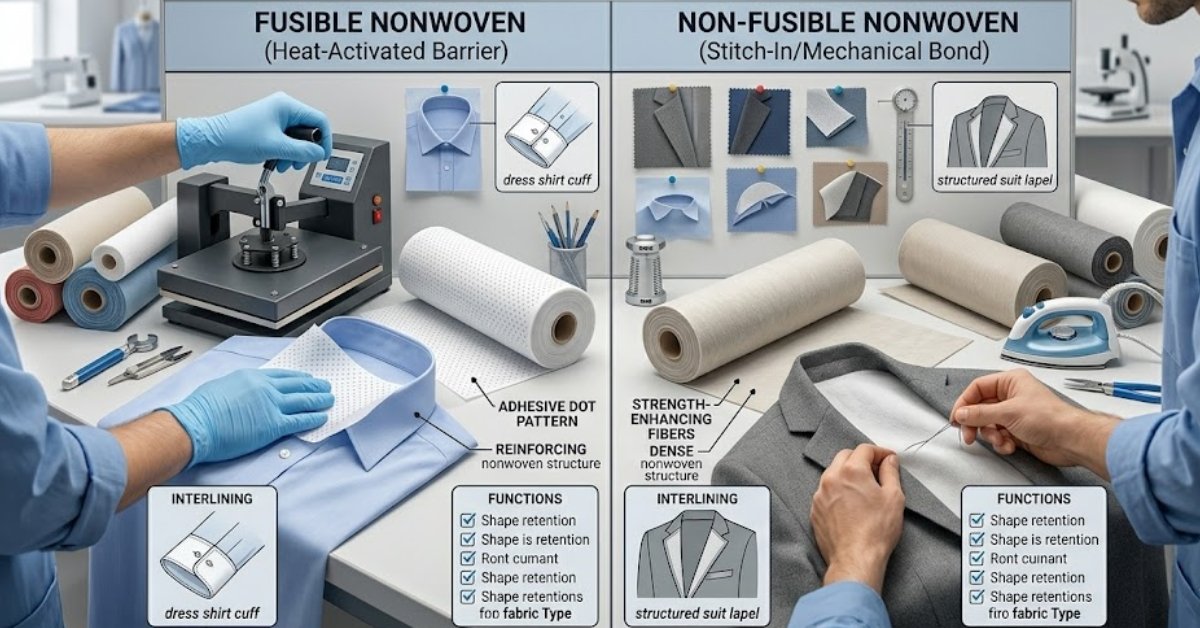
Interlining fabric is the hidden structural element in almost every garment that holds its shape. Jacket fronts, shirt collars, coat lapels, trouser waistbands, cuffs, plackets and pocket flaps — all rely on an interlining layer between the shell fabric and lining to provide stiffness, body, and dimensional stability. Without interlining, even the finest woven shell fabric would be floppy and shapeless in garment form.
Nonwoven interlining fabric — the dominant interlining type in mass-market and mid-market apparel — is manufactured from polyester, polypropylene, or viscose fibres bonded either thermally or chemically, without weaving. It is cost-effective, available in a wide range of stiffness levels and GSM weights, and can be supplied as fusible (with heat-activated adhesive backing) or sew-in (without adhesive) versions.
This guide covers the types of nonwoven interlining, construction methods, GSM selection for each garment application, fusing parameters, quality evaluation, and how to source nonwoven interlining fabric from Pakistan.
For a complete overview of all Textile & Industrial grade nonwoven fabrics we offer, see: Textile & Industrial Nonwoven Fabric — Full Product Range
Nonwoven Interlining Types — Construction Methods
Nonwoven interlining fabric is classified by its bonding method, which determines its hand feel, drape, wash stability, and suitability for different garment applications:
| Type | Bonding method | Feel | Wash stability | Typical use |
|---|---|---|---|---|
| Thermal-bonded (heat-fused) | Hot calendar press bonds fibres | Soft, drapeable | Excellent — binder-free | Shirts, blouses, dresses |
| Chemical-bonded (resin-bonded) | Acrylic/polyurethane binder | Firmer, structured | Good | Collars, cuffs, jacket front |
| Needle-punched nonwoven | Mechanical entanglement | Bulky, high-loft | Good | Shoulder pads, quilted jackets |
| Spunbond PP non-woven | Thermally bonded continuous | Light, crisp | Excellent | Interlining, disposable garments |
| Wet-laid (paper-like) nonwoven | Paper-process binder | Stiff, paper-like | Poor — not washable | Packaging interleaf, collar stays |
To understand the difference between thermal-bonded spunbond and SMS/SMMS structures,
see: SMS vs SMMS Nonwoven Fabric — What’s the Difference?
Fusible vs Sew-In Interlining — Which to Specify?
Fusible nonwoven interlining
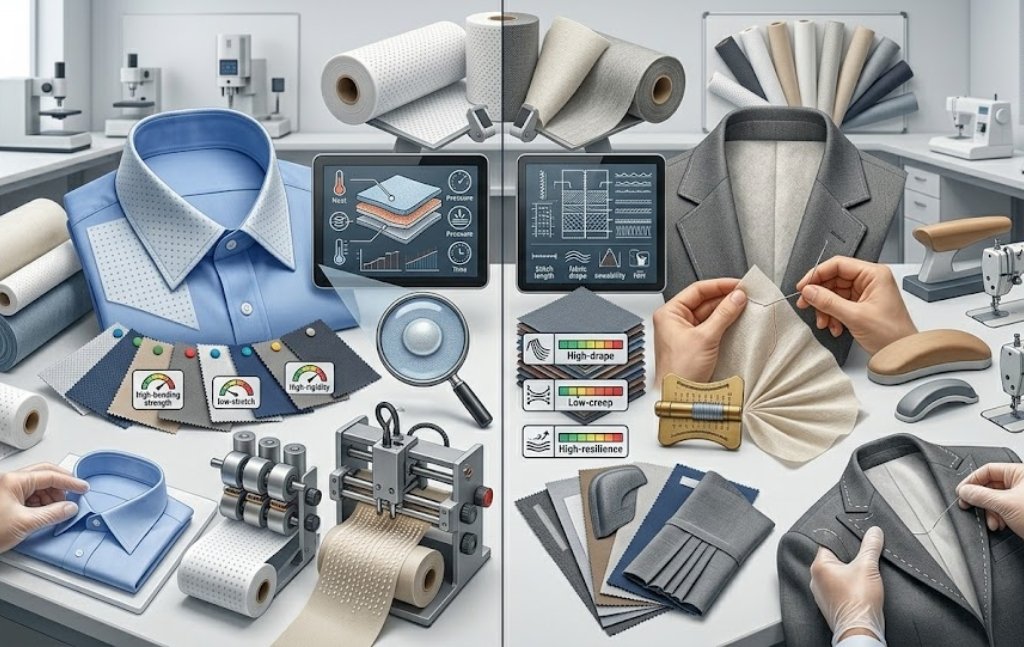
Fusible interlining has a dot-coated or scatter-coated thermoplastic adhesive (polyamide / PA or polyester / PES) applied to one side. When pressed against the wrong side of the shell fabric under heat (130–160°C), pressure, and time (8–15 seconds), the adhesive melts and bonds the interlining permanently to the shell fabric. Fusing eliminates the stitching step for interlining attachment, significantly improving garment production speed on industrial lines.
Fusible interlining is the dominant choice for:
- Shirt collars and collar bands — precise fusing gives the clean, rigid edge profile consumers expect
- Jacket front panels — fusing stabilises the shell fabric and prevents bagging after extended wear
- Trouser waistbands — fused interlining prevents the waistband from rolling or distorting
- Cuffs, plackets, pocket flaps — any garment component where edge stability and shape retention are required
Sew-in (non-fusible) nonwoven interlining
Sew-in interlining has no adhesive and is attached to the shell fabric by stitching. It is used where fusing temperatures would damage a delicate shell fabric (silk, metallic, sequinned), where wash durability of the fusible bond cannot be guaranteed for the intended wash programme, or where the design requires the interlining to move slightly independently of the shell fabric for a particular drape effect.
Sew-in nonwoven interlining is preferred for:
- Couture and luxury garments where hand-basting is the finishing technique
- Shell fabrics with heat-sensitive finishes (metallic coatings, embossed PU, laminated fabrics)
- Outerwear requiring heavy-duty construction where stitched interlining provides higher peel strength than fused bonding
GSM Selection Guide — Nonwoven Interlining by Garment Application
| Garment application | Interlining type | GSM range | Stiffness | Adhesive type |
|---|---|---|---|---|
| Shirt collar & collar band | Chemical-bonded fusible | 35 – 50 GSM | Medium-high | PA double-dot |
| Shirt front placket | Thermal-bonded fusible | 20 – 30 GSM | Light | PA scatter |
| Dress shirt cuff | Chemical-bonded fusible | 35 – 45 GSM | Medium-high | PA double-dot |
| Jacket front canvas | Chemical-bonded fusible | 50 – 90 GSM | High | PES powder/PA scatter |
| Jacket lapel | Thermal-bonded fusible | 25 – 40 GSM | Medium | PA scatter |
| Trouser waistband | Chemical-bonded fusible | 50 – 80 GSM | High | PA double-dot/PES |
| Light dress/blouse | Thermal-bonded fusible | 15 – 25 GSM | Very light | PA scatter |
| Outerwear/overcoat | Needle-punched sew-in | 80 – 150 GSM | Very high | None (sew-in) |
| Cap / hat brim | Spunbond PP fusible | 25 – 40 GSM | Light-medium | PA scatter |
To choose the correct GSM for collars, cuffs and waistbands,
see: What Is GSM in Nonwoven Fabric? GSM Meaning, Chart & How to Choose
Adhesive Types in Fusible Nonwoven Interlining
The thermoplastic adhesive on fusible nonwoven interlining is the most critical variable for both fusing performance and wash durability. Two adhesive types dominate the market:
Polyamide (PA) adhesive — the standard choice
PA adhesive is the most widely used fusible interlining adhesive globally. It fuses at 130–150°C, delivers strong initial bond strength, and provides good dry-cleaning resistance. PA is specified for shirt collars, dress shirts, trousers and jackets for both dry clean and machine wash (warm cycle up to 40°C) garments.
- Fusing temperature: 130 – 150°C
- Fusing pressure: 0.3 – 0.5 bar
- Fusing time: 10 – 15 seconds
- Wash durability: good to 40°C machine wash; excellent dryclean
Polyester (PES) adhesive — for high-wash durability
PES adhesive is specified where garments will undergo repeated high-temperature washing (60°C or above) — workwear, hospitality uniforms, medical scrubs, and childrenswear. PES requires a slightly higher fusing temperature (145–165°C) but delivers significantly better bond strength retention after multiple 60°C wash cycles versus PA.
- Fusing temperature: 145 – 165°C
- Fusing pressure: 0.3 – 0.5 bar
- Fusing time: 12 – 18 seconds
- Wash durability: excellent to 60°C; suitable for hospital and institutional laundry
Quality Testing for Nonwoven Interlining Fabric
Before committing to a nonwoven interlining supplier, request or conduct the following quality tests on samples:
- Peel strength after fusing (ISO 6330 / AATCC 135): bond strength between interlining and shell fabric after fusing. Minimum 10 N/5cm is typical; premium shirt collar interlining should achieve > 20 N/5cm.
- Wash durability (ISO 6330 at 40°C / 60°C): peel strength retention after 5 wash cycles. Reject any interlining that shows more than 30% peel strength loss after washing to the garment’s care label temperature.
- Dimensional stability (ISO 6330): the interlining must not shrink more than 3% in machine or cross direction after fusing and washing. Interlining shrinkage causes shell fabric puckering — the most visible quality defect in finished garments.
- GSM consistency: roll-to-roll variation must be within ±10% to ensure consistent stiffness in production. Request certificate per roll.
- Strike-back (adhesive bleed): the adhesive must not bleed through the interlining and stain the shell fabric or the pressing equipment. Test by fusing to a white shell fabric and checking for adhesive show-through on both sides.
Sourcing Nonwoven Interlining Fabric from Olefins, Pakistan
Olefins Private Limited supplies PP spunbond nonwoven fabric that serves as the base fabric for nonwoven interlining production, and can supply finished fusible interlining for garment manufacturers across GCC, Bangladesh and South Asia:
- PP spunbond base fabric: 15–80 GSM in white, used as the non-woven base for interlining coating operations
- Light fusible interlining: 18–35 GSM thermal-bonded PP nonwoven with PA scatter adhesive — for shirt collars, cap liners, light dress applications
- Economy sew-in interlining: 25–50 GSM chemical-bonded nonwoven — for disposable and single-wash garment applications
- Custom width: 90 cm, 112 cm, 150 cm standard; other widths on request
- OEM supply: production against buyer specification; suitable for garment accessory distributors and vertically integrated apparel manufacturers
- Export from Karachi: 7 days to UAE/GCC; competitive pricing vs Chinese supply for GCC and South Asian garment manufacturers
What Is the Difference Between Woven and Non-Woven Interfacing?
Woven interfacing is made by weaving warp and weft yarns on a loom, giving it directional stretch and a fabric-like drape. Non-woven interfacing is bonded directly from fibres, so it has no grain line, resists fraying at cut edges, and is more cost-effective — making it the standard choice for mass-market and mid-market garment interlining.
Frequently Asked Questions — Nonwoven Interlining FabricWhat is the difference between fusible and sew-in interlining?
Fusible interlining has a heat-activated adhesive coating that bonds permanently to the shell fabric under heat and pressure using a fusing press. Sew-in interlining has no adhesive and is attached by stitching. Fusible is faster in production and gives a cleaner finish for collars and structured garment components. Sew-in is used for delicate or heat-sensitive shell fabrics and couture applications.
What GSM nonwoven interlining is used for shirt collars?
Shirt collar interlining is typically 35–50 GSM chemical-bonded nonwoven with PA double-dot adhesive coating. This GSM range provides the medium-high stiffness needed for a crisp collar edge while remaining compatible with standard shirt fusing press conditions (135–145°C, 0.3 bar, 12 seconds).
Is nonwoven interlining better than woven interlining?
Nonwoven interlining is better for cost efficiency, production speed and consistency in mass-market to mid-market apparel. Woven interlining (hair canvas, resin interlining) is preferred for luxury tailoring, bespoke suiting, and applications where the natural drape and recovery properties of a woven structure are required. Most garments below mid-luxury price points use nonwoven interlining for its cost, consistency and process compatibility.
What is the difference between fusible and sew-in interlining?
Fusible interlining has a heat-activated adhesive coating that bonds permanently to the shell fabric under heat and pressure using a fusing press. Sew-in interlining has no adhesive and is attached by stitching. Fusible is faster in production and gives a cleaner finish for collars and structured garment components. Sew-in is used for delicate or heat-sensitive shell fabrics and couture applications.
What GSM nonwoven interlining is used for shirt collars?
Shirt collar interlining is typically 35–50 GSM chemical-bonded nonwoven with PA double-dot adhesive coating. This GSM range provides the medium-high stiffness needed for a crisp collar edge while remaining compatible with standard shirt fusing press conditions (135–145°C, 0.3 bar, 12 seconds).
Is nonwoven interlining better than woven interlining?
Nonwoven interlining is better for cost efficiency, production speed and consistency in mass-market to mid-market apparel. Woven interlining (hair canvas, resin interlining) is preferred for luxury tailoring, bespoke suiting, and applications where the natural drape and recovery properties of a woven structure are required. Most garments below mid-luxury price points use nonwoven interlining for its cost, consistency and process compatibility.
Request Nonwoven Interlining Fabric Sample — Olefins Pakistan
info@olefins.net | WhatsApp +92 316 2055400.
Post a comment
Related Posts
Crop Cover & Mulching Nonwoven Fabric — Frost Protection & UV Shield Guide
Last updated on: August 13, 2026 Introduction Polypropylene spunbond nonwoven fabric has transformed commercial agriculture…

Geotextile Nonwoven Fabric — Road, Drainage & Erosion Control Guide
Last updated on: August 13, 2026 Introduction Geotextiles are one of the largest volume applications…
Nonwoven Fabric for Furniture: Backing, Dust Cover & Padding Guide
Last updated on: August 13, 2026 The furniture industry is one of the largest consumers…