



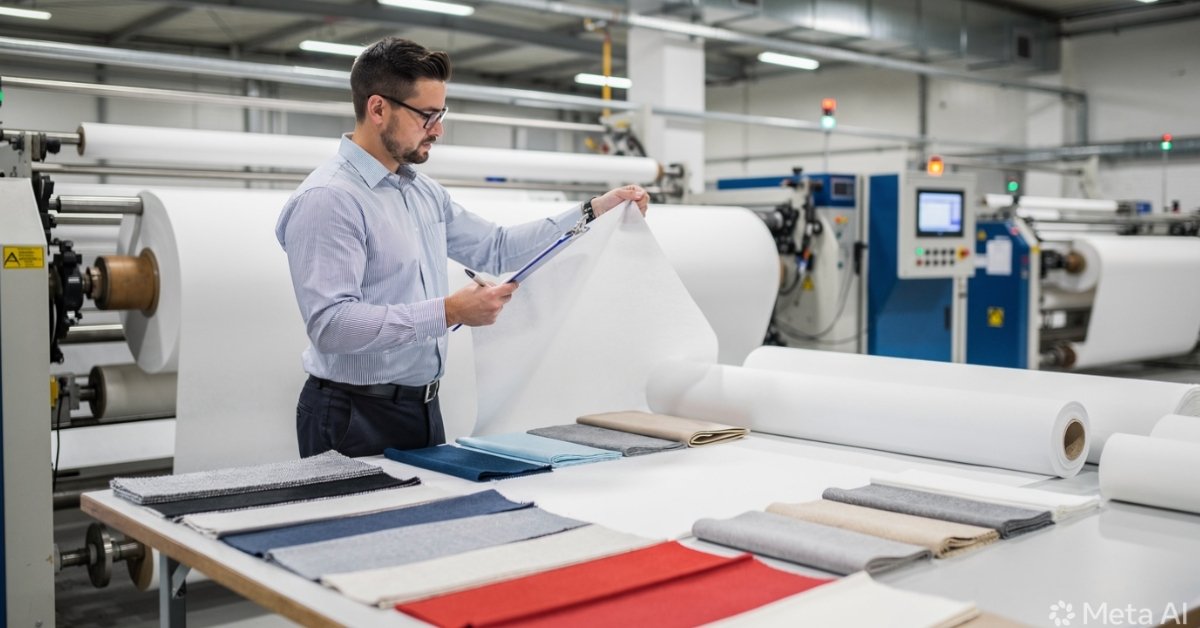
Choosing the wrong nonwoven fabric manufacturer can cost you far more than the difference in price. Inconsistent GSM means your production line rejects rolls. Unreliable delivery shuts down your factory. Poor communication means problems go unresolved. And substandard fabric ends up in your finished product — reaching your customers.
Whether you are evaluating your first nonwoven supplier or reviewing an existing one, these are the 10 most important questions to ask — and what the answers should look like.
Quick Summary: 10 Questions at a Glance — Red Flags vs Good Answers
| # | Question to Ask | Red Flag Answer | What Good Answer Looks Like |
|---|---|---|---|
| 1 | Machinery & Origin | “Latest machines” (vague) | Brand + Year: Reifenhäuser RF4 2023, Oerlikon |
| 2 | Test Reports for GSM | Only certificate, no data | Actual batch report: GSM, MD/CD tensile, elongation |
| 3 | Monthly Capacity (tonnes) | Vague / cannot specify | Specific: 200 tonnes/month spunbond |
| 4 | GSM Tolerance & Control | “Tolerance is not a problem” | ±5% standard, ±3% premium, online beta-gauge |
| 5 | Certifications / Audits | No certs at all | ISO 9001, OEKO-TEX 100, AAMI/EN13795 for medical |
| 6 | Factory Visit / Inspection | Unwilling to allow visit | Welcomes visit / third-party inspection (SGS, BV) |
| 7 | Lead Time & Urgent Orders | Any lead time without spec check | Standard 15-20 days + notification protocol for delay |
| 8 | MOQ & Trial Order | No MOQ or refuses trial | 500-2,000 kg MOQ, trial at premium for new buyers |
| 9 | Payment Terms / L/C | 100% advance only for large order | 30% advance / 70% BL, L/C accepted – export history |
| 10 | International References | Cannot name any industry | Provides industry/geography refs: Hygiene, Medical, GCC |
1. What machinery do you use for production, and what is its origin?
Why ask: Machinery quality directly determines fabric quality and consistency. A manufacturer using European or Japanese equipment (Reifenhäuser, Oerlikon, Laendering) operates at a fundamentally different level than one using generic machinery. Ask for the equipment brand and year of manufacture. Red flag: vague answers like ‘latest machines’ without specifics.
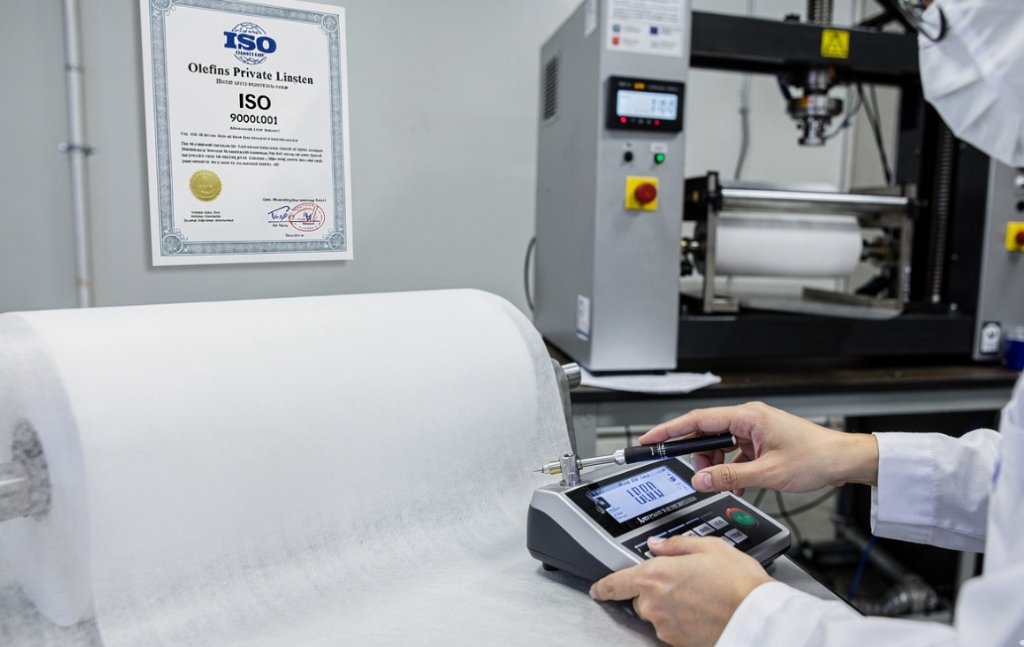
2. Can you provide test reports for the specific GSM I need?
Why ask: Any legitimate manufacturer tests every production batch. Ask for actual test reports — not just certificates — showing GSM accuracy (multiple sampling points across roll width), tensile strength (MD and CD), and elongation. Red flag: only able to provide certificates, not actual measurement data.
3. What is your actual monthly production capacity in tonnes?
Why ask: A manufacturer with 200 tonnes/month capacity can commit to your 50 tonne order without risk. A 50 tonne/month manufacturer cannot. If your volumes grow, will they keep up? Red flag: vague answer or inability to give a specific number.
4. What is your GSM tolerance — and how do you control it?
Why ask: Industry standard is ±5% GSM tolerance. Premium manufacturers achieve ±3%. This matters enormously for automated production lines where roll-to-roll consistency is critical. Ask how GSM is monitored during production. Red flag: ‘tolerance is not a problem’ without specifying actual numbers.
5. Do you have any quality certifications or third-party audits?
Why ask: ISO 9001 quality management certification shows the manufacturer has documented, auditable processes. OEKO-TEX certification is important for skin-contact hygiene applications. Third-party buyer audits are a strong positive signal. Red flag: no certifications at all, especially for medical or hygiene applications. See our guide on which certifications to ask for.
6. Can I visit your factory or have an independent inspector visit?
Why ask: Legitimate manufacturers welcome factory visits or third-party inspection. This single question separates real manufacturers from traders or brokers claiming to be manufacturers. Red flag: unwilling to allow factory visits or third-party inspection.
7. What is your standard lead time, and how do you handle urgent orders?
Why ask: Lead time reliability affects your production planning. Ask not just the standard lead time but what happens if your order is delayed — how are you notified and what remedies are offered? Red flag: can quote any lead time without clearly understanding your specification (suggests they are sourcing from a third party).
8. What is your minimum order quantity, and what happens if I need a small trial order?
Why ask: Established manufacturers have real MOQs based on production economics (typically 500–2,000 kg for nonwoven). A MOQ of ‘1 roll’ or no MOQ often indicates a trader. A willingness to accommodate a small trial order at a premium for new buyers shows confidence in their product. Red flag: no MOQ at all, or refusing any trial order.
9. What payment terms do you offer, and do you accept Letter of Credit?
Why ask: Established exporters are comfortable with standard international payment methods including Letter of Credit. L/C acceptance indicates a company with a proper banking relationship and export history. Red flag: demands 100% advance payment only, especially for large orders, with no flexibility.
10. Can you provide references from other international buyers?
Why ask: A manufacturer with satisfied international customers will confidently provide references or at minimum describe their customer base by industry and geography. Red flag: unable to name any industries they supply or unwilling to provide any buyer reference.
Olefins answers all 10 of these questions with confidence. We welcome factory visits, provide full test reports, have been exporting for over a decade, and build long-term partnerships with our buyers.
If you are sourcing specifically from Pakistan:
- For pricing, MOQ, product range and export markets, read Sourcing Nonwoven Fabric from Pakistan
- For step-by-step import process, supplier shortlisting and quality protocol, see our Complete Buyer’s Guide — How to Source from Pakistan
Start with a sample: info@olefins.net or WhatsApp +92 316 2055400
Frequently Asked Questions (FAQs)What is the most important question to ask a nonwoven fabric manufacturer?
Machinery origin and test reports. A manufacturer using European equipment (Reifenhäuser, Oerlikon) with actual batch test reports for GSM, tensile strength (MD/CD) and elongation operates at a fundamentally different level than one giving vague answers like ‘latest machines’ and only certificates.
What GSM tolerance is acceptable for automated production lines?
Industry standard is ±5% GSM tolerance. Premium manufacturers achieve ±3% using online beta-gauge monitoring. For automated diaper or lamination lines where roll-to-roll consistency is critical, always ask for actual tolerance numbers, not ‘tolerance is not a problem’.
Can I visit your factory or send a third-party inspector?
Legitimate manufacturers welcome factory visits or third-party inspection (SGS, Bureau Veritas). This single question separates real manufacturers from traders or brokers claiming to be manufacturers. If they refuse, it is a major red flag.
What MOQ should I expect for nonwoven fabric?
Established manufacturers have real MOQs based on production economics, typically 500–2,000 kg per GSM/colour. A MOQ of ‘1 roll’ or no MOQ often indicates a trader. Good manufacturers usually accommodate a small trial order at a premium for new buyers to build confidence.
What is the most important question to ask a nonwoven fabric manufacturer?
Machinery origin and test reports. A manufacturer using European equipment (Reifenhäuser, Oerlikon) with actual batch test reports for GSM, tensile strength (MD/CD) and elongation operates at a fundamentally different level than one giving vague answers like ‘latest machines’ and only certificates.
What GSM tolerance is acceptable for automated production lines?
Industry standard is ±5% GSM tolerance. Premium manufacturers achieve ±3% using online beta-gauge monitoring. For automated diaper or lamination lines where roll-to-roll consistency is critical, always ask for actual tolerance numbers, not ‘tolerance is not a problem’.
Can I visit your factory or send a third-party inspector?
Legitimate manufacturers welcome factory visits or third-party inspection (SGS, Bureau Veritas). This single question separates real manufacturers from traders or brokers claiming to be manufacturers. If they refuse, it is a major red flag.
What MOQ should I expect for nonwoven fabric?
Established manufacturers have real MOQs based on production economics, typically 500–2,000 kg per GSM/colour. A MOQ of ‘1 roll’ or no MOQ often indicates a trader. Good manufacturers usually accommodate a small trial order at a premium for new buyers to build confidence.
Post a comment
Related Posts
How to Choose & Source Nonwoven Fabric Manufacturers in Pakistan: Complete Buyer’s Guide
Sourcing high-quality polypropylene (PP) spunbond and composite nonwoven fabrics from Pakistan requires a strategic approach…
Nonwoven Fabric vs Plastic: Why PP Spunbond is the Smarter Choice
Manufacturers and procurement teams frequently face a choice between polypropylene nonwoven fabric and conventional plastic…
Nonwoven Fabric in Pakistan — Industry Overview & Export Capabilities 2026
Pakistan’s textile industry is one of the largest in the world, contributing over 60% of…
Top 10 Uses of Nonwoven Fabric in Everyday Products — 2026 Guide
Nonwoven fabric is one of the most widely used materials in modern manufacturing — yet…