



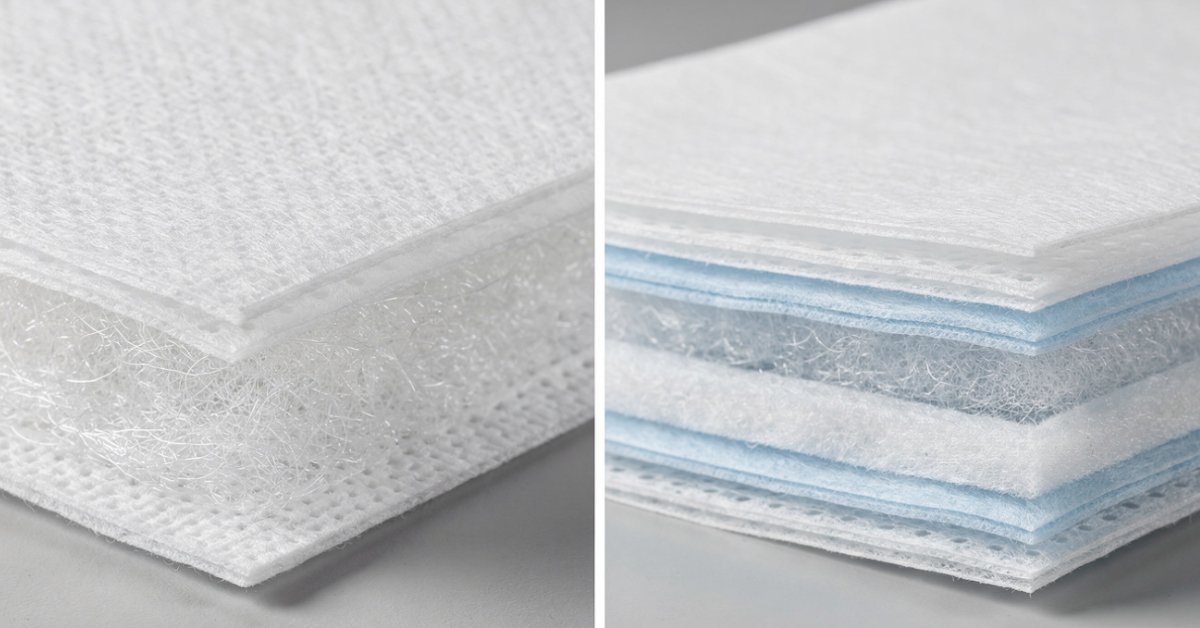
If you source medical nonwoven fabric for hygiene or protective applications, you have likely encountered SMS and SMMS. Both are spunmelt fabrics combining spunbond and meltblown layers — but they are not the same product, and choosing the wrong one can affect performance, cost, and compliance. For export requirements, see nonwoven fabric certifications.
SMS vs SMMS — The Short Answer
SMS is a three-layer nonwoven: spunbond, meltblown, spunbond. SMMS is a four-layer nonwoven: spunbond, meltblown, meltblown, spunbond. The extra meltblown layer in SMMS gives a more uniform and more reliable barrier at the same total fabric weight, because two thinner meltblown layers cover pinhole defects that a single thicker layer can leave open.
In practice: specify SMS for isolation gowns, Type 5 and Type 6 coveralls, caps, shoe covers and general protective workwear. Specify SMMS where the barrier is doing medical work — surgical gowns at AAMI Level 3, surgical drapes, sterile wraps and high-risk PPE. SMMS typically costs 8–15% more than SMS at equal GSM. For weight selection, see what is GSM in nonwoven fabric.
What Does SMS Stand For?
SMS stands for Spunbond-Meltblown-Spunbond. It is a three-layer composite nonwoven fabric made by combining one meltblown layer sandwiched between two spunbond layers, all thermally bonded together in a single production pass.
- S (Spunbond outer layer): Provides strength, tear resistance, and fabric-like hand feel
- M (Meltblown middle layer): Provides the barrier — filtration, liquid repellency, and bacterial protection
- S (Spunbond inner layer): Second strength layer that protects the fragile meltblown and provides softness
What Does SMMS Stand For?
SMMS stands for Spunbond-Meltblown-Spunbond. It is a four-layer composite with two meltblown layers instead of one. This doubled meltblown core provides significantly enhanced barrier performance compared to SMS at the same total GSM.
The Role of the Meltblown Layer
The meltblown layer is the functional heart of both constructions. It is a web of microfibers that creates a tortuous path for fluids and bacteria. In SMS, one meltblown layer does the work. In SMMS, two lighter meltblown layers are laid on top of each other — if one has a microscopic pinhole, the second covers it. This is why SMMS shows more consistent hydrostatic head results in lot testing.
SMS vs SMMS — Full Specification Comparison
Technical Performance — SMS vs SMMS
| Property | SMS (S-M-S) | SMMS (S-M-M-S) |
|---|---|---|
| Layer structure | 3 layers | 4 layers (Double Meltblown) |
| Barrier performance | Good | Excellent (30–50% better) |
| Hydrostatic Head | 30–50 cm H₂O | 50–100+ cm H₂O |
| Bacterial Filtration (BFE) | >95% at standard GSM | >99% at same GSM |
Buying Guide — GSM, Cost & Best Applications
| Criteria | SMS | SMMS |
|---|---|---|
| Fabric softness | Excellent | Very good |
| Cost | Lower | 10–20% higher than SMS |
| Typical GSM range | 25–45 GSM | 35–60 GSM (Olefins: 20-70 GSM) |
| Best applications | Surgical caps, light gowns, hygiene backsheets | Surgical gowns Level 2–4, PPE coveralls, medical drapes |
Barrier Performance: Hydrostatic Head and Fluid Resistance
Hydrostatic head to EN 20811 / AATCC 127 is the property the meltblown layer delivers. SMS typically achieves 30–50 cm H₂O, sufficient for AAMI Level 1-2. SMMS achieves 50–100+ cm H₂O due to double meltblown, meeting AAMI Level 3 requirement of ≥50 cm H₂O. This is the fastest way to detect a fabric that was sold as SMS but manufactured as SS.
Cost Difference and When the Premium Is Justified
SMMS is typically 10–20% higher in cost than SMS at the same GSM due to additional meltblown and lower line speed. However, for high-barrier applications, SMMS allows you to achieve required barrier at lower GSM than SMS, which often offsets cost difference. For general protective workwear where breathability matters more than fluid resistance, SMS delivers same practical result at lower cost.
When to Choose SMS
- Surgical caps, shoe covers, and visitor gowns — where high barrier is not required
- Baby diaper backsheets — for liquid resistance without premium barrier
- Light-duty disposable coveralls for food processing or light industrial use
- Feminine hygiene components where moisture management matters more than barrier
When to Choose SMMS
- Surgical gowns — AAMI Level 2, 3, or 4 rated — where fluid resistance is performance-critical (Level 3 requires ≥50 cm H₂O)
- Isolation gowns for infectious disease environments
- High-risk PPE coveralls for healthcare and laboratory
- Medical drapes for sterile surgical procedures
- Any application requiring hydrostatic pressure resistance above 60 cm H₂O
SSMMS and Higher-Layer Constructions
Beyond SMS and SMMS, some manufacturers offer SSMMS (two spunbond layers on the outside) for higher tensile strength. For most standard medical and hygiene applications, SMS and SMMS cover the full range. For related applications, explore our guides on interlining nonwoven fabric, geotextile nonwoven fabric, and crop cover nonwoven fabric.
Mapping Construction to AAMI PB70 Barrier Level
- Level 1: SMS 20-25 GSM — surgical caps, shoe covers
- Level 2: SMS 35-45 GSM or SMMS 35 GSM — light gowns, drapes
- Level 3: SMMS 35-55 GSM (≥50 cm H₂O) — standard surgical gowns
- Level 4: SMMS 40-60 GSM + laminate — high-risk surgical gowns
Key Testing Standards for SMS and SMMS Fabric
- ASTM F1670/F1671 — Synthetic blood and viral penetration resistance
- EN 13795 — European standard for surgical drapes and gowns (Level 3 ≥50 cm H₂O)
- EN 20811 / AATCC 127 — Hydrostatic head
- ASTM F2101 — Bacterial Filtration Efficiency (BFE)
Frequently Asked Questions — SMS vs SMMSIs SMMS always better than SMS?
No. SMMS is better where barrier uniformity matters. For applications that need coverage and breathability rather than fluid resistance — Type 6 coveralls, caps, shoe covers, mask outer layers — SMS delivers the same practical result at lower cost. Paying the SMMS premium for a Level 1 isolation gown is money spent on a property the product does not need.
What GSM SMS fabric is used for isolation gowns?
Level 1 and Level 2 isolation gowns are typically made from 35–45 GSM SMS. Below 35 GSM the garment feels flimsy in use and seam strength becomes marginal; above 45 GSM you are paying for barrier the AAMI level does not require.
Can SMS fabric be sterilised?
Yes. Polypropylene SMS and SMMS are compatible with ethylene oxide and gamma irradiation sterilisation. Autoclave steam sterilisation is not suitable — polypropylene softens near 130 °C.
What is the difference between hydrophobic and anti-alcohol treatment?
Hydrophobic finish repels water and aqueous fluids. Anti-alcohol (or ‘three-anti’) treatment additionally repels alcohol and blood, which have lower surface tension and will pass through a merely hydrophobic fabric. Surgical gowns and drapes generally specify anti-alcohol treatment.
How do I verify the meltblown layer in a fabric I have received?
Test hydrostatic head to EN 20811 and compare against your specification — this is the property the meltblown layer delivers, and it is the fastest way to detect a fabric that was sold as SMS but manufactured as SS. Request lot-level test reports as a condition of supply.
Is SMMS always better than SMS?
No. SMMS is better where barrier uniformity matters. For applications that need coverage and breathability rather than fluid resistance — Type 6 coveralls, caps, shoe covers, mask outer layers — SMS delivers the same practical result at lower cost. Paying the SMMS premium for a Level 1 isolation gown is money spent on a property the product does not need.
What GSM SMS fabric is used for isolation gowns?
Level 1 and Level 2 isolation gowns are typically made from 35–45 GSM SMS. Below 35 GSM the garment feels flimsy in use and seam strength becomes marginal; above 45 GSM you are paying for barrier the AAMI level does not require.
Can SMS fabric be sterilised?
Yes. Polypropylene SMS and SMMS are compatible with ethylene oxide and gamma irradiation sterilisation. Autoclave steam sterilisation is not suitable — polypropylene softens near 130 °C.
What is the difference between hydrophobic and anti-alcohol treatment?
Hydrophobic finish repels water and aqueous fluids. Anti-alcohol (or ‘three-anti’) treatment additionally repels alcohol and blood, which have lower surface tension and will pass through a merely hydrophobic fabric. Surgical gowns and drapes generally specify anti-alcohol treatment.
How do I verify the meltblown layer in a fabric I have received?
Test hydrostatic head to EN 20811 and compare against your specification — this is the property the meltblown layer delivers, and it is the fastest way to detect a fabric that was sold as SMS but manufactured as SS. Request lot-level test reports as a condition of supply.
Available in 20–70 GSM with hydrophobic or hydrophilic surface treatment, in white and surgical blue or green. Request a free sample. Olefins Private Limited manufactures SMS and SMMS nonwoven fabrics for medical, hygiene, and safety applications. Contact us at info@olefins.net or WhatsApp +92 316 2055400
Previous Post
Non-Woven Fabric for Baby Diapers — Complete Guide
Post a comment
Related Posts
How to Choose & Source Nonwoven Fabric Manufacturers in Pakistan: Complete Buyer’s Guide
Sourcing high-quality polypropylene (PP) spunbond and composite nonwoven fabrics from Pakistan requires a strategic approach…
Nonwoven Fabric vs Plastic: Why PP Spunbond is the Smarter Choice
Manufacturers and procurement teams frequently face a choice between polypropylene nonwoven fabric and conventional plastic…
Nonwoven Fabric in Pakistan — Industry Overview & Export Capabilities 2026
Pakistan’s textile industry is one of the largest in the world, contributing over 60% of…
How to Choose a Nonwoven Fabric Manufacturer — 10 Questions to Ask Before Buying
Choosing the wrong nonwoven fabric manufacturer can cost you far more than the difference in…