



If you are sourcing nonwoven fabric for a manufacturing application, you will quickly encounter two terms: spunbond and spunmelt. Both are polypropylene-based nonwoven fabrics produced through similar initial processes — but they differ significantly in structure, performance, and applications.
Understanding the difference between spunbond and spunmelt (also called SMS or spunmelt composite) is essential for specifying the right material for your product. This guide from Olefins explains both clearly.
What is Spunbond Nonwoven Fabric?
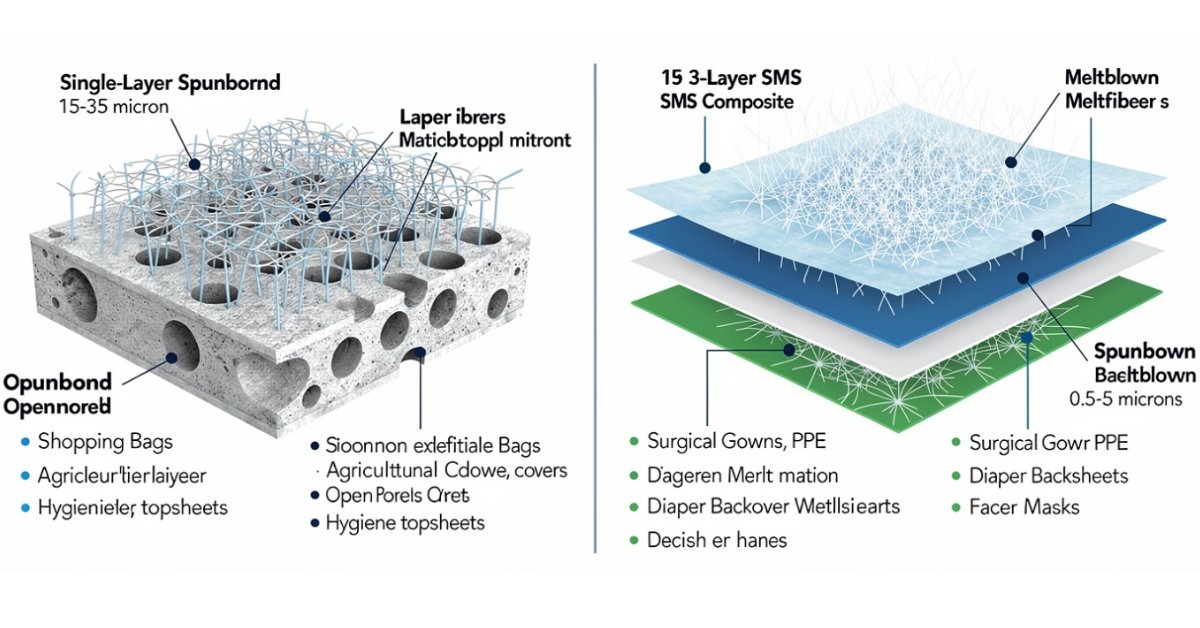
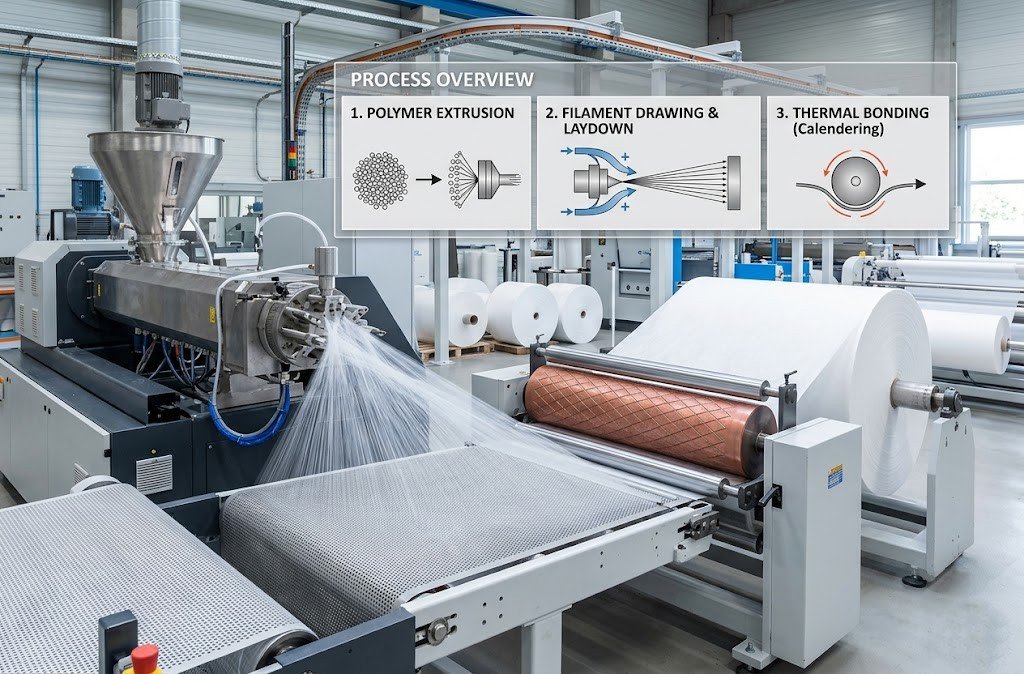
Spunbond is the base technology. Polymer granules are melted, extruded through spinnerets, drawn into fine filaments by high-speed air, deposited onto a conveyor to form a web, and thermally bonded by heated calendar rollers. The result is a single-layer fabric with consistent GSM, good tensile strength, and a uniform open structure.
Key characteristics: continuous filament construction (15–35 micron fibre diameter), open pore structure (breathable but not a barrier), good MD and CD tensile strength, soft hand feel at fine GSM, excellent uniformity and cost-effectiveness.
What is Spunmelt (SMS/SMMS) Nonwoven Fabric?
Spunmelt fabric adds a meltblown layer between spunbond layers. Meltblown uses extremely fine die holes and very high-velocity hot air to produce micro-fibres of 0.5–5 microns — 10× finer than spunbond. These micro-fibres create a dense barrier layer. SMS (Spunbond-Meltblown-Spunbond) and SMMS (double meltblown) are the most common constructions. All layers are produced and bonded in a single continuous pass.
| Property | Spunbond | Spunmelt (SMS/SMMS) |
|---|---|---|
| Construction | Single layer of bonded filaments | 2–4 layer composite with meltblown core |
| Fibre diameter | 15–35 microns | Spunbond 15–35μm + meltblown 0.5–5μm |
| Barrier performance | Low — open structure | High — meltblown core blocks particles & liquid |
| Softness | Excellent | Very good |
| Strength | High | High (spunbond layers carry load) |
| Breathability | High | Moderate (meltblown reduces air flow) |
| Cost | Lower | 15–40% higher than spunbond |
| Best use | Bags, hygiene, agri, packaging | Medical gowns, PPE, hygiene backsheet |
When to Choose Spunbond
- Shopping bags, agricultural covers, furniture backing — where barrier is not needed
- Hygiene product topsheets — soft skin-contact layers requiring hydrophilic treatment
- Geotextiles — where drainage and separation matter more than barrier
- Packaging and wrapping — where breathability and cost are the priorities
- Disposable light workwear — lab coats, caps, shoe covers not requiring fluid protection
When to Choose Spunmelt (SMS/SMMS)
- Surgical gowns and drapes — fluid barrier is a clinical safety requirement
- PPE coveralls for chemical or biological hazard environments
- Baby diaper backsheets — hydrophobic barrier preventing reverse flow
- Medical masks — SMS outer/inner with meltblown filtration layer
- Any application requiring hydrostatic head pressure resistance
Olefins manufactures both spunbond and spunmelt (SMS/SMMS) nonwoven fabrics. Not sure which is right for your application? Send us your product details and we will recommend the correct specification.
Contact us: info@olefins.net | WhatsApp: +92 316 2055400
Post a comment
Related Posts

Crop Cover & Mulching Nonwoven Fabric — Frost Protection & UV Shield Guide
Introduction Polypropylene spunbond nonwoven fabric has transformed commercial agriculture over the past three decades. What…
Nonwoven Interlining Fabric — Fusible & Non-Fusible Guide for Apparel Manufacturers
Introduction Interlining fabric is the hidden structural element in almost every garment that holds its…

Geotextile Nonwoven Fabric — Road, Drainage & Erosion Control Guide
Introduction Geotextiles are one of the largest volume applications for nonwoven fabric globally — second…
Medical Nonwoven Fabric Certifications — AAMI, EN 13795, ISO & OEKO-TEX Guide
Introduction Sourcing nonwoven fabric for medical, surgical or safety products without understanding the relevant certification…